
Flour Tortilla Recipe Soft, Flexible & Ready in 30 Minutes
A homemade flour tortilla recipe is one of those kitchen projects that sounds more involved than it actually is — and produces results so far ahead of store-bought that the comparison almost isn’t fair. Soft, pliable, and slightly charred at the edges, a fresh flour tortilla works for burritos, tacos, wraps, quesadillas, or eaten warm with nothing but butter. No complicated steps — just pure flour tortilla satisfaction, soft and fresh off the griddle in 30 minutes.
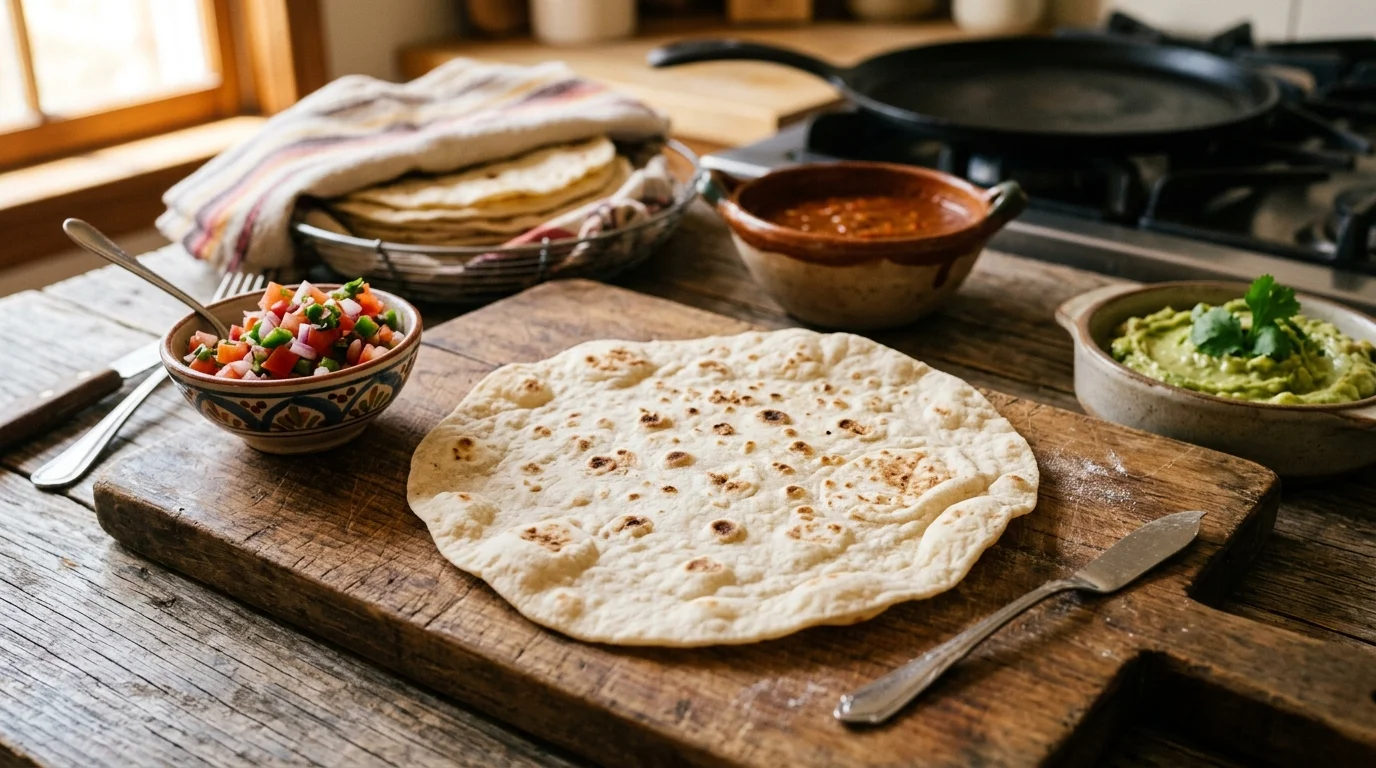
Ingredients
For the Flour Tortillas (makes 8 medium tortillas):
- 2 cups (240g) all-purpose flour [plus extra for dusting]
- ¾ tsp fine salt
- ½ tsp baking powder [gives the tortilla a slight puff and softness]
- 3 tbsp vegetable shortening, lard, or unsalted butter [cold, cut into small pieces]
- ¾ cup (180ml) warm water [around 110°F — warm but not hot]
Optional Variations:
- 1 tsp garlic powder [for a garlic herb tortilla] (optional)
- 1 tsp dried oregano or mixed herbs (optional)
- 1 tbsp whole wheat flour [replace 1 tbsp of all-purpose for a slightly nuttier flavour] (optional)
Equipment:
- Rolling pin
- Cast iron skillet or heavy griddle
- Large mixing bowl
- Plastic wrap or clean kitchen towel
Step-by-Step Instructions
Step 1: Gather and Prep Your Ingredients
Measure every ingredient before mixing begins. The fat must be cold — cold fat cut into flour produces a flakier, more tender tortilla than warm or melted fat that incorporates too smoothly and loses its texture-building function. Cut the shortening or butter into small pea-sized pieces directly from the refrigerator. Have the warm water measured and at the counter — too hot and it activates the gluten aggressively, producing a tough, elastic tortilla.
Pro Tip: Cold fat + warm water is the correct combination — don’t switch the temperatures between the two.
Step 2: Make the Dough
Whisk the flour, salt, and baking powder together in a large bowl. Add the cold fat pieces and work them into the flour using your fingertips — rub the fat into the flour until the mixture resembles coarse, uneven breadcrumbs with some pea-sized pieces remaining. Pour the warm water in gradually, mixing with a fork until a shaggy dough forms. Turn onto the counter and knead for 2 minutes until smooth and soft but not sticky.
Pro Tip: Don’t overwork — 2 minutes of kneading is enough. Over-kneaded dough makes tough, chewy tortillas.
Step 3: Rest the Dough
Divide the kneaded dough into 8 equal pieces — use a kitchen scale for uniform tortillas, approximately 55–60g each. Roll each piece into a smooth ball between your palms. Place on a plate, cover with plastic wrap or a damp kitchen towel, and rest for 15–20 minutes at room temperature. This rest period is essential — it allows the gluten to relax so the dough rolls thin without springing back.
Pro Tip: Never skip the rest — unrested dough fights the rolling pin and produces thick, uneven tortillas.
📖 Read More: Chicken Tortilla Soup
Step 4: Roll the Tortillas Thin
On a lightly floured surface, roll each dough ball into a thin, roughly round disc — approximately 20–22cm (8 inches) in diameter and 1–2mm thick. Roll from the centre outward in all directions, rotating the dough a quarter turn with each roll. Imperfect circles are fine — rustic edges are a sign of homemade. The key is consistent thickness across the whole tortilla, not a perfect shape.
Pro Tip: Lift and rotate the dough after every few rolls — it prevents sticking and produces even thickness throughout.
Step 5: Cook on a Dry, Hot Skillet
Heat a dry cast iron skillet or heavy griddle over medium-high heat until a drop of water evaporates immediately on contact. Cook each rolled tortilla for 45–60 seconds on the first side — small bubbles will appear across the surface and the underside will develop golden-brown spots. Flip and cook for 30–45 seconds on the second side. The tortilla should puff slightly and have visible char spots — this is correct and desirable.
Pro Tip: A properly hot, dry skillet with no oil produces the best char and texture — never add oil to the pan.
Step 6: Rest Under a Towel and Serve
Transfer each cooked flour tortilla to a clean kitchen towel and fold the towel over to cover. Stack the tortillas under the towel as they come off the skillet — the steam trapped between them softens the exterior and keeps them pliable for filling and folding. Serve warm within 10–15 minutes for the best texture. A freshly made flour tortilla eaten warm from the stack needs nothing more than a light spread of butter.
Pro Tip: The towel steam method is what makes homemade tortillas soft and pliable — never skip it.
Cook Time
Total Time: 30 minutes | Mix and Knead: 8 minutes | Rest: 15 minutes | Roll and Cook: 12 minutes No oven required.
Servings
Makes 8 medium flour tortillas — approximately 20cm (8 inches) each.
Nutritional Information (approx. per tortilla — plain, no fillings)
| Nutrient | Amount |
|---|---|
| Calories | 160 kcal |
| Fat | 5g |
| Saturated Fat | 2g |
| Carbohydrates | 25g |
| Protein | 4g |
| Sugar | 0g |
| Fiber | 1g |
| Sodium | 190mg |
| Vitamin C | 0mg |
| Potassium | 45mg |
| Calcium | 30mg |
Values are approximate and will vary based on ingredients used.
Storage Instructions
Fresh flour tortillas are best eaten warm on the day they’re made — the texture is softest and most pliable in the first hour off the griddle. Store cooled tortillas in a zip-lock bag or wrapped tightly in plastic wrap at room temperature for up to 2 days. Refrigerate for up to 5 days — bring to room temperature or warm briefly in a dry skillet before using. Cold tortillas crack when folded.
For freezing, stack the cooled tortillas with a small square of parchment paper between each one to prevent sticking. Place the stack in a sealed freezer bag and freeze for up to 3 months. Thaw at room temperature for 20–30 minutes, or warm individual tortillas directly in a dry skillet from frozen for 45–60 seconds per side. Frozen homemade tortillas reheat to near-fresh quality every time.
Suggestions
- Whole Wheat Flour Tortillas: Replace half the all-purpose flour with whole wheat flour. The tortilla has a nuttier, slightly denser flavour and a marginally less pliable texture. Add an extra tablespoon of warm water to compensate for the higher absorbency of whole wheat flour. A solid everyday version with more fibre than the plain white version.
- Lard-Based Flour Tortillas: Replace the shortening or butter with rendered lard — the most traditional fat used in authentic northern Mexican flour tortillas. Lard produces the most flavourful, most pliable, and most authentic-tasting result. If lard is available, use it without hesitation — the flavour difference is significant and immediately noticeable.
- Garlic Herb Flour Tortillas: Add 1 teaspoon of garlic powder and 1 teaspoon of dried mixed herbs to the flour before adding the fat. These tortillas work particularly well for wraps and quesadillas where the herb flavour complements the filling. They cook identically to the plain version — no technique adjustment needed.
- Extra Large Burrito-Sized Tortillas: Divide the dough into 4 equal pieces instead of 8. Roll each piece to approximately 30cm (12 inches) in diameter — as thin as possible without tearing. Cook slightly longer — 60–70 seconds per side. These oversized tortillas produce a proper burrito-sized wrap that holds a full filling without splitting.
- Gluten-Free Tortillas: Replace all-purpose flour with a 1:1 gluten-free baking flour blend that contains xanthan gum. Add 1 extra tablespoon of warm water — gluten-free flours absorb more liquid. The dough will be slightly stickier and less elastic than wheat dough — roll between two sheets of parchment rather than on a floured surface. Cook identically.
- Flavoured Spinach Tortillas: Blend ½ cup of fresh baby spinach with the warm water until completely smooth. Use this green water in place of plain warm water. The spinach turns the dough a vivid green without adding any detectable spinach flavour — visually striking and naturally dye-free.
- Smaller Street Taco Tortillas: Divide the dough into 12–14 equal pieces instead of 8. Roll each to approximately 12–14cm (5 inches) in diameter — the classic street taco size. Cook for 30–40 seconds per side. These smaller tortillas are the most practical format for tacos, tostadas, and any recipe that needs individual portions rather than a full wrap.
- Butter-Based Flour Tortillas: Use cold unsalted butter instead of shortening — cut into pieces and worked into the flour the same way. Butter tortillas have a richer, slightly more flavourful result than shortening versions and a beautiful golden colour when cooked. They’re slightly less pliable than lard or shortening tortillas but genuinely excellent for any filling.
Seasonal Relevance
A flour tortilla recipe is a genuinely year-round staple with no seasonal dependency — the four ingredients are always available at consistent quality and price. That said, the dishes they’re best used in shift naturally with the season. From May through September, fresh flour tortillas shine as taco wrappers and quesadilla bases filled with peak-season produce — grilled corn, fresh tomatoes, and ripe avocado. From October through March, the same tortillas wrap hearty fillings — braised meats, refried beans, and warm stews — that suit the cold-weather appetite perfectly.
Conclusion
A homemade flour tortilla recipe is one of the most rewarding 30-minute kitchen projects available — the technique is simple, the ingredients are four pantry staples, and the result makes every dish it’s used in taste noticeably better. Rest the dough, roll it thin, cook on a dry hot skillet, and steam under a towel immediately. Get those four things right and you’ll never reach for a store-bought packet again. Try the lard version for authenticity, the whole wheat for nutrition, or the spinach version for something visually striking. Make a batch — they disappear faster than you expect.
FAQs
Q: Why are my flour tortillas tough and not pliable? Tough tortillas come from one of three causes — not enough fat in the dough, insufficient rest time before rolling, or overcooking on the griddle. Fat is what creates tenderness — don’t reduce it. The 15–20 minute rest is essential for gluten relaxation. Overcooking dries the tortilla out and makes it crack — 45–60 seconds on the first side and 30–45 on the second is the correct timing.
Q: Can I make flour tortilla dough ahead of time? Yes — the dough keeps well covered in the refrigerator for up to 2 days before rolling and cooking. Remove from the refrigerator 20 minutes before rolling to let the fat soften slightly — cold dough rolls less smoothly and tears more easily. The dough can also be divided into balls, wrapped individually in plastic wrap, and refrigerated — roll and cook each one fresh to order for the softest possible result.
Q: What fat makes the best flour tortillas? Lard produces the most authentic, most flavourful, and most pliable result — it is the traditional fat used in northern Mexico for centuries and nothing fully replicates its effect on tortilla texture. Vegetable shortening is the most widely accessible substitute and produces excellent, consistent results. Cold unsalted butter adds flavour but slightly less pliability than lard or shortening. Vegetable oil works but produces a flatter, less interesting result than any solid fat.
