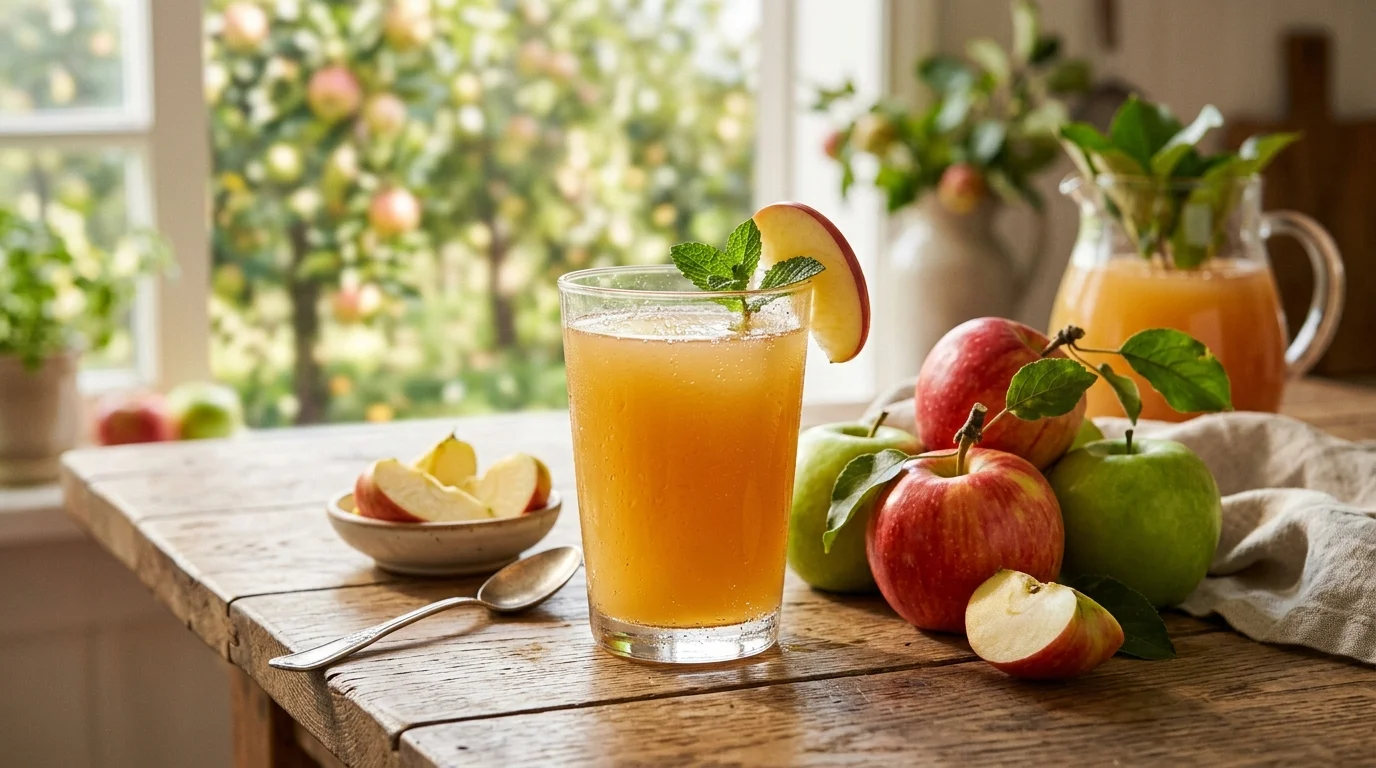
Apple Juice Fresh, Crisp & Ready in 10 Minutes
Fresh apple juice is one of those drinks that makes you wonder why you ever bought it in a bottle. It’s naturally sweet, deeply flavourful, and completely different from anything that comes off a supermarket shelf. It works as a morning drink, an afternoon refresher, a post-workout rehydration, or the base of a dozen cocktails and mocktails. No complicated steps — just pure apple juice freshness, pressed and ready in 10 minutes.
Ingredients
For the Apple Juice (serves 2–4):
- 6–8 medium apples [Fuji, Gala, Honeycrisp, or a mix for balanced sweetness and acidity]
- 1 cup cold water [to help the blender process the apples smoothly]
- 1 tbsp fresh lemon juice [prevents browning and adds brightness]
- 1 tsp honey or maple syrup [optional — only if apples are less sweet than desired]
- ¼ tsp ground cinnamon [optional — adds warm spice depth]
- Pinch of fine salt [optional — enhances natural sweetness]
For Serving:
- Ice cubes or large ice spheres
- Apple slices or cinnamon stick, for garnish
- Chilled glasses
Equipment:
- Blender or juicer
- Fine mesh strainer or cheesecloth
- Large jug or pitcher
Step-by-Step Instructions
Step 1: Gather and Prep Your Ingredients
Wash the apples thoroughly under cold running water. Core each apple and cut into rough chunks — no need to peel, as the skin adds flavour and nutrients. Choose the ripest, heaviest apples available for the most juice yield and the best natural sweetness. A mix of sweet and tart varieties like Fuji and Granny Smith produces the most balanced, complex apple juice.
Pro Tip: Cold apples yield slightly less juice than room-temperature ones — let them sit out for 15 minutes before processing.
Step 2: Blend the Apples
Add the apple chunks and cold water to a blender. Blend on high speed for 60–90 seconds until the mixture is completely smooth and uniform. The water helps the blades move freely and prevents the blender from straining against the dense apple flesh. Work in two batches if your blender is smaller than 6 cups to avoid overflow and ensure even blending throughout.
Pro Tip: Don’t skip the water — dry apple chunks can damage blender blades and produce uneven results.
Step 3: Strain the Juice
Pour the blended apple mixture through a fine mesh strainer or cheesecloth-lined colander into a large jug. Press the back of a spoon firmly against the pulp to extract every drop of juice. For a clearer, pulp-free apple juice, strain twice. For a thicker, more nutrient-rich version, press lightly and allow some fine pulp through. The choice is entirely yours.
Pro Tip: Save the apple pulp — it works perfectly in oatmeal, muffins, or smoothies.
📖 Read More: 15 Best Alcoholic Drinks
Step 4: Check Consistency and Adjust
Hold the jug up to the light — fresh apple juice should look golden-amber and slightly hazy from natural apple compounds. If it looks very pale or thin, the apples were under-ripe. Add the lemon juice now to prevent oxidation and brighten the flavour. Stir well. If the juice looks too thick after straining, add a small splash of cold water and stir.
Pro Tip: The haziness in fresh juice is natural — it means nothing has been filtered out.
Step 5: Taste and Fine-Tune
Taste the strained juice and assess the balance. Fresh apple juice from ripe fruit needs nothing added. If it tastes flat, a pinch of fine salt sharpens everything immediately. If it’s too tart, a teaspoon of honey dissolved in warm water and stirred through corrects it. If you’re adding cinnamon, stir it in now and let the juice sit for 2 minutes before serving.
Pro Tip: Always taste before adding sweetener — ripe seasonal apples rarely need any.
Step 6: Pour, Garnish, and Serve
Pour the fresh apple juice over large ice cubes in tall, clear glasses — the amber colour looks best against clear glass. Garnish with a thin apple slice balanced on the rim or a cinnamon stick rested against the inside of the glass. Serve immediately while the flavour is at its most vivid and the aroma is still fully present. Fresh apple juice waits for no one.
Pro Tip: Chill the glasses in the freezer for 5 minutes before pouring for the coldest possible serve.
Cook Time
Total Time: 10 minutes | Prep: 5 minutes | Blend and Strain: 5 minutes No cooking required.
Servings
Makes approximately 2 cups (480ml) — serves 2 to 4 depending on glass size.
Nutritional Information (approx. per serving — 1 cup / 240ml, no added sweetener)
| Nutrient | Amount |
|---|---|
| Calories | 114 kcal |
| Fat | 0.3g |
| Saturated Fat | 0g |
| Carbohydrates | 28g |
| Protein | 0.5g |
| Sugar | 23g |
| Fiber | 0.5g |
| Sodium | 10mg |
| Vitamin C | 5mg |
| Potassium | 295mg |
| Calcium | 17mg |
Values are approximate and will vary based on ingredients used.
Storage Instructions
Fresh apple juice is best consumed within 15–20 minutes of pressing — the volatile aroma compounds fade quickly and oxidation begins turning the colour from golden to brown. Store in a sealed, airtight glass bottle or jar filled to the brim to minimise air contact. Refrigerate for up to 48 hours. Shake before serving since natural sediment settles at the bottom.
For longer storage, freeze fresh apple juice in ice cube trays. Once solid, transfer to a sealed freezer bag and store for up to 3 months. Use the frozen cubes in smoothies, cocktails, or thaw individually for a single-glass serve. Never store at room temperature once made — fresh juice with no preservatives spoils within hours.
📖 Read More: Orange Juice
Suggestions
- Spiced Apple Juice: Add a cinnamon stick, 2 cloves, and a slice of fresh ginger to the strained juice and let it steep for 5 minutes. Serve warm in mugs for a cosy autumn drink or over ice for a refreshing cold version. Perfect for October through December.
- Apple Ginger Detox Juice: Blend apples with 1 inch of fresh ginger root and a squeeze of lemon before straining. The ginger adds anti-inflammatory benefits and a sharp, warming edge. This is the most health-forward version and works well as a morning wellness shot.
- Sparkling Apple Juice: Mix equal parts fresh apple juice and chilled sparkling water or sparkling mineral water in a glass over ice. This low-calorie, no-added-sugar fizzy drink is perfect for gatherings as a non-alcoholic alternative that looks elegant and drinks beautifully.
- Green Apple Detox Blend: Use all Granny Smith apples and blend with ½ a cucumber, a handful of baby spinach, and a squeeze of lime. The green colour is vivid, the flavour is tart and refreshing, and the nutritional profile is significantly higher than plain juice.
- Apple Carrot Orange Juice: Blend apples with 2 medium carrots and the juice of 1 orange before straining. The result is naturally sweet, deeply coloured, and packed with beta-carotene and vitamin C. A kid-friendly, plant-based option that genuinely tastes like a treat.
- Apple Juice Smoothie Bowl: Reduce the water by half to make a thicker apple juice base. Blend with 1 frozen banana and ½ cup of oats. Pour into a bowl and top with granola, apple slices, and a drizzle of honey. A filling, high-fibre breakfast that starts from the same base recipe.
- Weight-Loss Apple Juice: Use only green apples — Granny Smith — for the highest pectin content and lowest sugar level. Skip all added sweeteners, add extra lemon juice, and serve over ice without any garnish. Each serving comes in under 90 calories and provides natural fibre support.
- Apple Cinnamon Latte: Warm the fresh apple juice gently in a saucepan with a cinnamon stick and star anise. Froth 100ml of oat milk and pour over the warm spiced juice. It’s a naturally dairy-free warm drink that tastes like autumn in a cup.
Seasonal Relevance
Apple juice is at its absolute best from September through November when fresh apples are at peak ripeness, lowest price, and highest flavour complexity. Varieties like Honeycrisp, Fuji, and Gala are most vibrant during this harvest window. To extend the season, freeze pressed juice in ice cube trays at peak ripeness and use throughout winter. From December through August, rely on a mix of varieties available at your supermarket — combining sweet and tart apples always produces the most balanced result regardless of season.
Conclusion
Fresh apple juice is proof that the simplest ingredients, treated with a little attention, produce something genuinely worth making. Six apples, a blender, and a strainer is all it takes to produce a glass that supermarket bottles can’t touch. Try the spiced version in winter, the green detox blend in spring, and the sparkling version for any gathering that needs a beautiful non-alcoholic option. Once you make fresh apple juice at home, the bottle version stops making sense.
FAQs
Q: Which apples make the best apple juice? Fuji, Gala, and Honeycrisp produce the sweetest, most fragrant juice. Granny Smith adds tartness and is ideal for blending with sweeter varieties. A 50/50 mix of sweet and tart apples produces the most balanced, complex flavour. Avoid Red Delicious — they’re low in juice content and produce a flat, one-dimensional result.
Q: Why does my fresh apple juice turn brown so quickly? Browning is caused by oxidation — the enzyme polyphenol oxidase in apple flesh reacts with air immediately after cutting and pressing. Adding lemon juice to the batch slows this reaction significantly. Storing in a sealed, airtight container filled to the brim reduces air contact. Browning doesn’t affect flavour or safety — it’s purely cosmetic.
Q: Can I make apple juice without a blender or juicer? Yes — grate the apples using a box grater, then press the grated pulp firmly through a cheesecloth or clean kitchen towel over a bowl. It takes more effort than a blender but produces excellent juice. Twist the towel tightly and squeeze hard for maximum yield. This method works well for small batches of 2–3 apples.