Matcha Smoothie Earthy, Creamy & Ready in 5 Minutes
A matcha smoothie is the morning drink that gives you everything a cup of coffee does — calm, focused energy without the spike and crash — and then adds a thick, creamy, genuinely delicious glass of something worth looking forward to every day. Matcha brings a clean, sustained caffeine lift from its L-theanine content, a distinctive earthy-sweet flavour that pairs beautifully with banana and milk, and a vivid green colour that makes the drink look as deliberate as it tastes.
It works as a pre-workout energiser, a breakfast that takes under 5 minutes to build, a mid-afternoon focus drink, or a healthy dessert alternative when you want something creamy and satisfying without the sugar load of anything more indulgent. No complicated steps — just pure matcha smoothie goodness, blended and ready in 5 minutes flat.
Ingredients
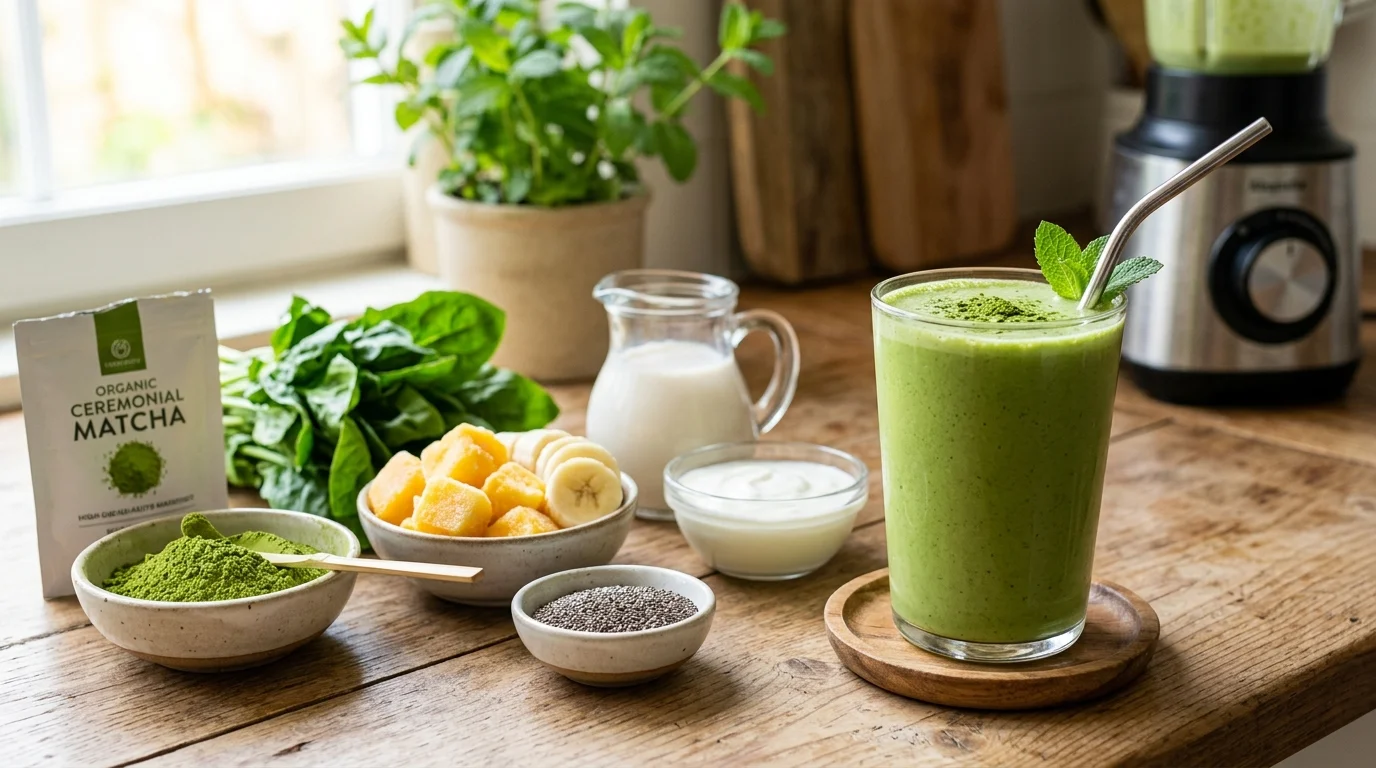
For the Matcha Smoothie Base (serves 1–2):
- 1 tsp ceremonial or culinary grade matcha powder [sifted]
- 2 medium bananas [frozen — non-negotiable for the best texture]
- 1 cup unsweetened almond milk [or oat milk, coconut milk, or whole milk]
- ½ cup plain Greek yogurt [adds creaminess and protein]
- 1 tbsp honey or maple syrup [adjust based on matcha bitterness]
- ½ tsp pure vanilla extract
- ½ cup ice cubes [skip entirely if using two frozen bananas]
- Pinch of fine salt
Optional Add-Ins for Extra Nutrition:
- 1 scoop vanilla protein powder (optional)
- 1 tbsp chia seeds or ground flaxseed (optional)
- ½ avocado — for extra creaminess and healthy fat (optional)
- 1 tsp spirulina — doubles the green nutrient density (optional)
- 1 tbsp almond butter or peanut butter (optional)
- ¼ tsp ground ginger — complements matcha naturally (optional)
- ½ cup frozen mango or pineapple — tropical sweetness (optional)
- 1 medjool date — natural sweetener alternative (optional)
For Serving:
- Dusting of matcha powder, for garnish
- Sliced banana or fresh fruit, for garnish
- Drizzle of honey, for finishing
- Granola, chia seeds, or toasted coconut, for texture (optional)
- Edible flowers, for presentation (optional)
Step-by-Step Instructions
Step 1: Gather and Prep Your Ingredients
Before the blender starts, prep the matcha carefully — this is the step that separates a smooth, vibrant matcha smoothie from a clumpy, bitter one. Sift the matcha powder through a fine mesh sieve into a small bowl rather than adding it directly to the blender jar. Unsifted matcha contains tiny clumps that don’t break down fully during blending and leave bitter, powdery pockets throughout the finished drink. Have the frozen bananas pulled from the freezer 3–4 minutes before starting, measure the yogurt, milk, and any optional add-ins, and set the honey beside the blender. Two minutes of organised prep here means the rest of the process is seamless.
Pro Tip: Quality matters more with matcha than with almost any other smoothie ingredient. Ceremonial grade matcha has a sweeter, more complex flavour with significantly less bitterness than culinary grade — it’s worth using for any matcha smoothie where the flavour is the point. Culinary grade works adequately and costs considerably less, but requires a slightly heavier hand with the honey to balance the more pronounced bitterness. Never use matcha that smells like hay or looks yellow-green — fresh, high-quality matcha is a vivid, bright green and smells grassy and slightly sweet.
Step 2: Pre-Dissolve the Matcha
Do not add matcha powder directly to a full blender jar of cold liquid and expect it to dissolve cleanly — it won’t. Instead, add the sifted matcha to a small bowl or cup with 2 tablespoons of warm water — around 70°C, not boiling — and whisk vigorously with a matcha whisk or a regular small whisk for 30–45 seconds until completely smooth, lump-free, and slightly frothy. This whisked matcha paste is what goes into the blender rather than dry powder. The warm water fully hydrates the matcha particles and creates a uniform paste that distributes completely through the smoothie during blending rather than sitting in clumps that never fully dissolve in cold liquid.
Pro Tip: Never use boiling water to dissolve matcha — water above 80°C burns the delicate chlorophyll compounds in the leaves that give matcha its characteristic flavour and vivid green colour. Burned matcha tastes more bitter and astringent than properly prepared matcha, and the colour turns from vivid emerald to a dull, yellow-tinged green. Warm water from a tap left to heat for 60 seconds, or boiled water rested for 3–4 minutes, sits at approximately the right temperature without any thermometer required.
Step 3: Build the Blender and Blend
Pour the almond milk into the blender jar first, followed by the whisked matcha paste, Greek yogurt, vanilla extract, honey, and the pinch of salt. Add the frozen banana chunks on top, followed by any optional add-ins. Place ice last if using — though with two frozen bananas, ice is rarely necessary. Start the blender on low for 15 seconds to pull the frozen banana into the vortex, then increase to maximum speed and blend for 60 full seconds until completely smooth. A matcha smoothie needs the full minute at high speed to ensure the matcha is fully distributed through the liquid and the frozen banana is completely broken down into a creamy, uniform texture.
Pro Tip: The pinch of salt is not optional in a matcha smoothie — salt suppresses the natural bitterness of matcha in the same way it does in coffee and dark chocolate. Without it, the matcha flavour reads as sharper and more astringent than it actually is. With it, the earthy sweetness comes forward and the bitterness recedes into the background where it belongs. Start with a small pinch and taste after blending before deciding whether more is needed.
📖 Read More: Banana Smoothie Recipe
Step 4: Check Consistency and Adjust
Tilt the blender jar 30 seconds after stopping the motor — the consistency should have settled to a thick, slow-moving pour rather than the airy texture immediately after blending. A properly built matcha smoothie sits somewhere between a thick milkshake and a drinkable yogurt — creamy and coating rather than thin and watery. If it’s thicker than you’d like, add almond milk one tablespoon at a time and pulse 3–4 times. If it’s thinner than ideal, add half a frozen banana or a tablespoon of Greek yogurt and blend for another 20 seconds. Do not over-blend at this adjustment stage — excessive blending beyond what’s needed generates heat that can dull the vivid green colour of the matcha.
Pro Tip: The colour of a matcha smoothie tells you a great deal about how it’s been built. A vivid, deep green colour means the matcha was properly dissolved, the banana ratio is balanced, and the blending was adequate. A yellow-green or pale green colour means either the matcha wasn’t fully dissolved before blending, the banana proportion is too high, or the matcha quality is low. A brownish green means the matcha was burned during preparation. Colour is the most honest indicator of how the smoothie will taste before a single sip is taken.
Step 5: Taste and Fine-Tune
Taste through a spoon before pouring and assess each element deliberately. The matcha smoothie should lead with the creamy, slightly sweet banana base and finish with the earthy, grassy note of the matcha — the two flavours should balance each other rather than one dominating. If the matcha is too prominent and bitter, add an extra half teaspoon of honey and blend briefly. If the banana is too dominant and the matcha is barely detectable, add another half teaspoon of sifted matcha dissolved in a small splash of warm water and blend for 10 seconds. If the whole smoothie tastes flat, an extra few drops of vanilla extract resolves it faster than any other adjustment.
Pro Tip: Matcha flavour intensifies as the smoothie sits — a freshly blended matcha smoothie that tastes balanced will taste noticeably more matcha-forward 10 minutes later as the flavour continues to steep into the cold liquid. If you’re making it ahead or allowing it to sit before drinking, under-season the matcha slightly during the taste stage and let the natural steeping do the rest. If drinking immediately, season to exactly where you want it.
Step 6: Pour, Garnish, and Serve
Pour the finished matcha smoothie into a chilled glass immediately — matcha oxidises slowly but the colour is most vivid within the first 10–15 minutes of blending. Tap the base of the glass gently on the counter to settle the contents and remove air bubbles. Use a fine mesh sieve to dust a thin, even layer of matcha powder across the surface for garnish — this is the visual signature of any matcha drink and takes 5 seconds. Add a drizzle of honey, a slice of fresh banana on the rim, and a sprinkle of chia seeds or toasted coconut flakes if using. Serve immediately with a wide straw or a long spoon for a thicker, bowl-style serving.
Pro Tip: For a matcha smoothie bowl, reduce the almond milk to ⅓ cup and use 2 fully frozen bananas with no additional ice. The result is thick enough to eat with a spoon and holds toppings — granola, sliced banana, chia seeds, and a matcha dusting — in place without sinking. The bowl format is significantly more filling than the drinkable version and works well as a complete breakfast.
Cook Time
Total Time: 5 minutes | Prep: 2 minutes | Matcha Prep: 1 minute | Blend: 2 minutes One blender, one small whisk — a perfect matcha smoothie ready in 5 minutes.
Servings
Makes 1 large serving (approximately 400–450ml) or 2 smaller servings.
Nutritional Information (approx. per full single serving — with almond milk, Greek yogurt, 2 bananas, 1 tsp matcha, no add-ins)
| Nutrient | Amount |
|---|---|
| Calories | 290 kcal |
| Fat | 5g |
| Saturated Fat | 1g |
| Carbohydrates | 52g |
| Protein | 12g |
| Sugar | 30g |
| Fiber | 5g |
| Sodium | 180mg |
| Vitamin C | 14mg |
| Potassium | 740mg |
| Calcium | 280mg |
Values are approximate and will vary based on ingredients used.
Storage Instructions
A matcha smoothie is best consumed immediately after blending — the flavour is most balanced, the colour is most vivid, and the texture is at peak thickness within the first 10–15 minutes of the blender stopping. After that, the matcha continues to steep into the cold liquid and the flavour intensifies, the banana oxidises slightly and the colour shifts from bright green toward a greener-brown, and the consistency may thicken further as the frozen banana continues to chill the yogurt. If storage is necessary, pour into a sealed mason jar filled as close to the brim as possible to limit air contact and refrigerate for up to 12 hours — shorter than most smoothies because the matcha flavour change is more pronounced over time. Add a small squeeze of fresh lemon or lime juice before sealing to slow oxidation and maintain the green colour as long as possible. Shake or stir before drinking as the matcha will have settled toward the bottom of the jar. For the best make-ahead approach, use the freezer pack method — portion the frozen banana and Greek yogurt into individual zip-lock bags, freeze flat, and blend fresh each morning with the pre-dissolved matcha and milk. The whole process takes under 3 minutes once the pack is frozen and the matcha is dissolved. The matcha paste itself can be pre-dissolved in warm water and stored in a small sealed container in the refrigerator for up to 24 hours — dissolving a batch for the week saves time every morning without any loss of quality.
📖 Read More: Protein Smoothie
Suggestions
- Matcha Banana Smoothie: The base recipe is already essentially this — but to push the banana flavour forward, use 2½ frozen bananas instead of 2 and reduce the honey to a half teaspoon. The extra banana produces a sweeter, thicker smoothie where the matcha sits more subtly in the background as a complementary note rather than the lead flavour. This is the most approachable version for anyone new to matcha who isn’t yet sure about the earthy, grassy flavour profile.
- Matcha Protein Smoothie: Add 1 scoop of vanilla protein powder to the base recipe alongside the Greek yogurt. Use oat milk instead of almond milk for a creamier, more substantial base that supports the additional protein content. This version delivers over 32g of protein per serving and works as a complete post-workout recovery drink — the L-theanine in the matcha supports focus and calm recovery while the protein supports muscle repair.
- Matcha Latte Smoothie: Replace the almond milk with equal parts oat milk and full-fat coconut milk — the coconut milk adds richness and a subtle tropical sweetness that creates a matcha smoothie closer in character to a thick, blended matcha latte than a fruit smoothie. Skip the banana entirely and use ½ cup of soaked, drained cashews instead for creaminess without the fruit sweetness. Add an extra teaspoon of honey and serve over a few large ice cubes rather than fully blended ice.
- Matcha Mango Smoothie: Replace one banana with 1 cup of frozen mango chunks. The tropical sweetness and bright acidity of mango cuts cleanly through the earthiness of the matcha and produces a lighter, more vibrant smoothie that works particularly well in warm weather. Use coconut milk as the liquid base and finish with a squeeze of fresh lime juice and a sprinkle of toasted coconut across the top for the full tropical effect.
- Chocolate Matcha Smoothie: Add 1 tablespoon of unsweetened cocoa powder to the base recipe before blending. The bitterness of the cocoa and the earthiness of the matcha share a similar flavour register — they amplify each other in a way that produces a complex, deeply flavoured smoothie that tastes genuinely sophisticated. Use chocolate protein powder if available and serve in a wide glass with cacao nibs scattered across the top.
- Matcha Avocado Smoothie: Add half a ripe avocado to the base recipe alongside the frozen banana. The avocado adds healthy monounsaturated fats, an extra layer of creaminess, and a natural richness that makes the matcha smoothie significantly more filling and sustaining than the base recipe. The colour deepens to a darker, more opaque green and the texture becomes almost pudding-like — ideal for a bowl format with toppings.
- Dairy-Free Matcha Smoothie: Replace the Greek yogurt with coconut yogurt or silken tofu and use full-fat coconut milk as the liquid base. Silken tofu blends completely smooth and adds protein without any detectable tofu flavour against the dominant matcha and banana — it simply adds body and creaminess. Use maple syrup rather than honey to keep the build entirely plant-based. The finished smoothie is indistinguishable from the dairy version in texture and colour.
- Weight-Loss Matcha Smoothie: Use one banana instead of two, replace the Greek yogurt with low-fat Greek yogurt, and use unsweetened almond milk — approximately 30 calories per cup — as the liquid base. Skip the honey and rely on the natural sweetness of the ripe banana and the vanilla extract. Add a tablespoon of chia seeds for fibre that extends satiety. This build comes in under 200 calories per large serving while still delivering the full matcha flavour, the creamy texture, and the clean energy benefit that makes a daily matcha smoothie worth building into a routine.
📖 Read More: Peanut Butter Smoothie
Seasonal Relevance
A matcha smoothie works in every season but the format that feels most appropriate shifts across the calendar. From May through September, the cold blended smoothie version is the natural choice — a thick, chilled matcha drink in the morning is genuinely refreshing in warm weather and one of the most pleasant ways to consume matcha during summer months when a hot matcha latte feels like too much. The mango matcha version specifically suits June through August when tropical fruit is at its most affordable and the flavour combination aligns naturally with the season. From October through February, the matcha smoothie shifts toward richer, warmer-adjacent builds — the coconut milk latte version, the chocolate matcha build, and the avocado variation all feel more appropriate for cold-weather mornings when a light fruit smoothie doesn’t feel substantial enough. Adding ginger to the base recipe from November through January adds a warming edge that suits the season far better than it does in summer. Spring, March through May, is when the matcha smoothie feels most aligned with the season’s energy — fresh starts, cleaner eating, and a morning drink that provides focus and calm rather than the hard caffeine jolt of coffee. The weight-loss version and the protein build get most use during this period as people reset routines and establish healthier morning habits ahead of summer.
Conclusion
A matcha smoothie earns its place in the daily routine because it delivers something that most morning drinks don’t — calm, focused energy from the L-theanine and caffeine combination in matcha, genuine flavour complexity from the earthy-sweet taste of the powder, and a creamy, satisfying texture from the frozen banana and Greek yogurt base. Get the matcha dissolved properly before blending, use frozen banana for the best texture, add the pinch of salt, and taste carefully before pouring. Those four details done right produce a matcha smoothie that is consistently better than anything available at a smoothie bar — and available in 5 minutes without leaving the kitchen. Work through the variations, find the version that fits your morning, and make it a habit. The benefits of daily matcha compound over time, and a smoothie is the fastest, most enjoyable way to get there.
FAQs
Q: What is the best matcha grade to use in a smoothie? Ceremonial grade matcha produces the sweetest, most complex, least bitter result and is the best choice for any matcha smoothie where flavour quality matters. It’s made from the youngest tea leaves and has a vivid green colour and a naturally smooth, umami-rich taste that needs minimal sweetener to balance. Culinary grade matcha is significantly less expensive and works adequately in a smoothie — it’s slightly more bitter and less vibrantly green than ceremonial grade, so increase the honey slightly and check the colour before blending. Never use low-quality matcha that looks yellow or brown — it has been oxidised and will produce a dull, unpleasantly bitter drink regardless of how it’s prepared.
Q: How much caffeine does a matcha smoothie have? One teaspoon of matcha powder contains approximately 60–70mg of caffeine — roughly two-thirds of an average shot of espresso. However, matcha’s caffeine is released differently from coffee’s because it’s bound to the amino acid L-theanine, which slows absorption and produces a steadier, longer-lasting energy curve rather than a sharp spike followed by a crash. Most people who switch from coffee to a daily matcha smoothie report feeling more alert and focused without the jitteriness or energy crash that coffee produces. If you’re caffeine-sensitive, start with ½ teaspoon of matcha and increase gradually over the first week.
Q: Why does my matcha smoothie taste bitter? Bitterness in a matcha smoothie comes from one of four causes — low quality matcha, water that was too hot during preparation which burned the delicate compounds, matcha that wasn’t fully dissolved before blending leaving concentrated bitter clumps, or simply too much matcha relative to the sweetening ingredients. Start by sifting the matcha, dissolving it in warm rather than boiling water, using a high-quality grade, and starting with 1 teaspoon rather than more. If bitterness persists, increase the honey by half a teaspoon, add an extra half banana, and ensure the pinch of salt is included — salt is the most effective single adjustment for reducing the perception of bitterness in matcha without masking its flavour entirely.