Hamburger Potato Casserole Hearty, Cheesy & Ready in 1 Hour
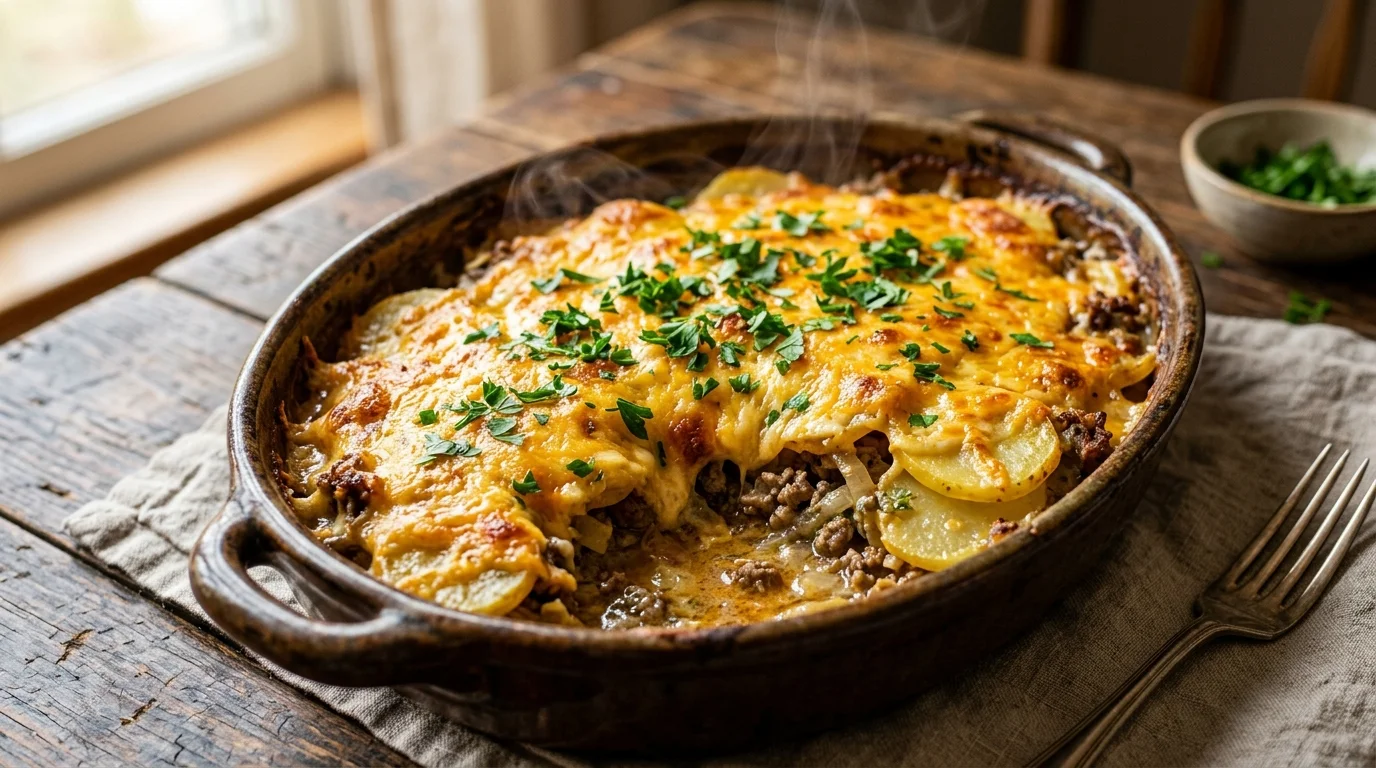
Hamburger potato casserole is the definition of a complete dinner in a single dish — seasoned ground beef, tender sliced potatoes, a rich creamy sauce, and a golden melted cheese topping all baked together in one pan until bubbling and deeply satisfying. It’s the kind of meal that fills the kitchen with the smell of something worth sitting down for and clears the table without a single complaint.
Every component is straightforward, every ingredient is affordable, and the result is genuinely impressive for how little effort it requires. Whether you’re feeding a family on a Tuesday night, contributing to a potluck, or making a batch that handles four days of lunches, hamburger potato casserole delivers on every count. No complicated steps — just pure hamburger potato casserole comfort, golden and bubbling from the oven in one hour.
Ingredients
For the Ground Beef Layer:
- 500g (1.1 lb) lean ground beef [80/20 for the best flavour]
- 1 medium yellow onion, finely diced
- 3 cloves garlic, minced
- 1 tbsp olive oil
- 1 tsp smoked paprika
- 1 tsp garlic powder
- 1 tsp onion powder
- ½ tsp dried thyme
- ½ tsp fine salt
- ½ tsp black pepper
- 1 tbsp Worcestershire sauce
- 1 tbsp tomato paste
For the Potato Layer:
- 900g (2 lb) Yukon Gold or Russet potatoes [thinly sliced — approximately 3mm thick]
- 1 tsp fine salt [for seasoning the potato slices]
- ½ tsp black pepper
- ½ tsp garlic powder
For the Cream Sauce:
- 1 can (10.5 oz) cream of mushroom soup [or cream of chicken]
- ½ cup sour cream
- ½ cup whole milk [or beef broth for a richer flavour]
- 1 tsp Dijon mustard
- ½ tsp smoked paprika
- Salt and black pepper, to taste
For the Cheese Topping:
- 2 cups shredded sharp cheddar cheese, divided
- ½ cup shredded Monterey Jack or Gruyère cheese
- Fresh chives or parsley, for garnish
Optional Add-Ins:
- 1 cup frozen peas, thawed (optional)
- ½ cup sliced mushrooms (optional)
- ½ cup diced bell pepper, sautéed (optional)
- 4 strips crispy bacon, crumbled into the beef layer (optional)
- ¼ tsp cayenne pepper — for heat (optional)
Step-by-Step Instructions
Step 1: Gather and Prep Your Ingredients
Before the oven goes on, prep every component so the assembly moves without interruption. Thinly slice the potatoes to approximately 3mm — a mandoline produces the most uniform slices and the fastest result, but a sharp knife with a steady hand works equally well. Uniform thickness is critical — thin slices cook through completely during baking while thick slices stay underdone and hard in the centre of the casserole, creating an unpleasant texture contrast. Dice the onion, mince the garlic, and have the cream sauce ingredients measured and ready. Season the potato slices with salt, pepper, and garlic powder and toss to coat evenly before any layering begins. Starting seasoned rather than seasoning as you layer ensures every potato slice is flavoured throughout rather than only on the top surface.
Pro Tip: Soak the sliced potatoes in cold water for 10 minutes after slicing, then drain and pat completely dry before seasoning. The cold water soak removes excess surface starch that would otherwise cause the potato layers to stick together in a gummy mass during baking. Dry potatoes season more evenly and produce distinctly layered slices in the finished hamburger potato casserole rather than a compressed potato block.
Step 2: Brown the Ground Beef
Heat 1 tablespoon of olive oil in a large oven-safe skillet or sauté pan over medium-high heat. Add the diced onion and cook for 3–4 minutes until softened and beginning to turn golden. Add the ground beef and break it apart thoroughly — spread it across the full pan surface and leave undisturbed for 2 minutes to develop browning. Cook for 6–8 minutes total until no pink remains and the meat has some golden colour at the edges. Drain the excess fat, leaving approximately 1 tablespoon in the pan. Add the minced garlic and stir for 60 seconds, then add the tomato paste and cook for 60 seconds more — letting it caramelise against the hot pan before any liquid touches it. Add the Worcestershire sauce, smoked paprika, garlic powder, onion powder, dried thyme, salt, and pepper. Stir to coat and remove from heat.
Pro Tip: The tomato paste caramelisation step is 60 seconds that makes the ground beef taste significantly more complex and deeply savoury than beef seasoned without it. Tomato paste cooked directly against a hot surface before liquid goes in loses its raw, tinny edge and develops a concentrated, almost meaty depth that carries through every layer of the finished hamburger potato casserole. Don’t skip it and don’t rush it.
Step 3: Make the Cream Sauce
In a medium bowl, combine the cream of mushroom soup, sour cream, whole milk, Dijon mustard, and smoked paprika. Whisk until completely smooth and well combined — no visible lumps of soup or streaks of unmixed sour cream. Taste the sauce before it goes into the casserole — it should be rich, slightly tangy from the sour cream, and well-seasoned. The cream sauce is the moisture source that cooks the potatoes through during baking and binds all the layers together — if it tastes flat or underseasoned at this stage, every layer of the finished casserole will taste flat too. Add salt and pepper to taste, and a pinch of smoked paprika if it needs more depth.
Pro Tip: Use beef broth in place of whole milk for a richer, more savoury cream sauce that amplifies the ground beef flavour throughout the casserole. The beef-forward version is noticeably more complex than the milk version and suits the overall flavour profile of the dish more naturally. Either option works — the choice is between a creamier, milder sauce and a richer, deeper one.
📖 Read More: Hamburger Casserole Recipes
Step 4: Layer the Casserole
Preheat the oven to 375°F (190°C). Lightly grease a 9×13-inch baking dish with cooking spray or butter. Spread half the seasoned potato slices across the base of the dish in an even, overlapping layer — like shingles on a roof rather than a random pile. Spoon half the cream sauce over the potato layer and spread gently. Add all of the seasoned ground beef in an even layer across the cream-sauced potatoes. Scatter 1 cup of the shredded cheddar evenly across the beef. Add the remaining potato slices in another overlapping shingle layer on top of the beef and cheese. Pour the remaining cream sauce over the top potato layer, spreading it to cover every potato slice completely — any exposed potato will dry out and turn leathery rather than becoming tender during baking.
Pro Tip: Press down firmly on each layer before adding the next — particularly the potato layers. Gently pressing the potato slices flat against each other eliminates air gaps that prevent the cream sauce from flowing through the layers during baking. Properly pressed, compact layers produce a casserole where every potato slice is evenly cooked and coated in sauce rather than some that are perfectly tender and others that are dry in the centre.
Step 5: Add the Cheese and Cover for Baking
Scatter the remaining shredded cheddar and the Monterey Jack or Gruyère cheese evenly across the top of the final cream sauce layer. The cheese goes on before the foil — it begins to melt and meld with the cream sauce during the covered bake before being exposed in the final uncovered stage, which produces a more deeply flavoured, cohesive cheese topping rather than cheese that only melts on the surface in the last 15 minutes. Cover the baking dish tightly with aluminium foil — tight coverage is essential. Steam trapped under the foil is what cooks the potatoes through during the first 40 minutes of baking — any gaps in the foil seal release steam and leave the potatoes undercooked in the centre. Bake covered at 375°F for 40–45 minutes.
Pro Tip: Seal the foil by crimping it firmly around all four edges of the baking dish rather than simply laying it across the top. A loose foil cover lets steam escape from the edges and concentrates the moisture loss at the corners of the casserole — exactly where the potato layers are thinnest and most vulnerable to drying out before the centre has cooked through.
Step 6: Uncover, Finish, and Rest
After 40–45 minutes, carefully remove the foil — steam will release rapidly from the dish, so lift the foil away from you. Check the potato doneness by inserting a sharp knife or skewer into the centre of the casserole — it should pass through every layer with no resistance. If the potatoes still feel firm, re-cover and bake for another 10 minutes before checking again. Once the potatoes are tender, leave the casserole uncovered and bake for a further 12–15 minutes until the cheese is fully melted, bubbling at the edges, and developing golden-brown patches across the surface. Rest the finished hamburger potato casserole for 8–10 minutes before serving — this rest time allows the cream sauce to thicken slightly from its bubbling state and makes each portion clean and intact when lifted rather than collapsing on the serving spoon.
Pro Tip: Test potato doneness from multiple positions in the baking dish — not just the centre. The edges of the casserole always cook faster than the middle, so a knife that passes easily through the edge doesn’t confirm the centre is done. Three doneness checks across the dish — edge, midway, and centre — give an accurate picture of whether the whole casserole is ready or whether the centre needs more covered bake time.
Cook Time
Total Time: 1 hour 20 minutes | Prep: 15 minutes | Beef and Sauce: 12 minutes | Covered Bake: 45 minutes | Uncovered Bake: 14 minutes | Rest: 8 minutes One skillet, one baking dish — hamburger potato casserole on the table in just over an hour.
Servings
Serves 6 generous portions from a standard 9×13-inch baking dish.
Nutritional Information (approx. per serving — based on 6 servings, with full cheese topping)
| Nutrient | Amount |
|---|---|
| Calories | 560 kcal |
| Fat | 30g |
| Saturated Fat | 14g |
| Carbohydrates | 38g |
| Protein | 36g |
| Sugar | 4g |
| Fiber | 3g |
| Sodium | 720mg |
| Vitamin C | 16mg |
| Potassium | 820mg |
| Calcium | 320mg |
Values are approximate and will vary based on ingredients used.
Storage Instructions
Hamburger potato casserole stores exceptionally well and is one of the most practical make-ahead dinners available. Allow the casserole to cool completely before covering the baking dish tightly with plastic wrap or transferring portions to airtight containers — sealing a hot casserole traps steam that makes the topping soggy and the sauce watery by morning. Refrigerate for up to 4 days. The flavour improves overnight as the beef and potato layers fully absorb the cream sauce seasoning. Reheat individual portions in the microwave loosely covered with a damp paper towel in 60-second intervals, adding a small splash of broth or milk over the top before reheating to restore the moisture absorbed during refrigeration. For reheating the full casserole, add 2–3 tablespoons of broth or milk across the surface, cover with foil, and warm at 325°F for 25–30 minutes until heated through — uncover for the final 5 minutes to re-melt the cheese surface. For freezing, the casserole freezes well both baked and unbaked. For the best result, freeze unbaked — assemble completely, cover with foil and then plastic wrap, and freeze for up to 2 months. Bake from frozen, covered, at 375°F for 75–80 minutes until the potatoes are completely tender, then uncover for the final 15 minutes. Already-baked casserole freezes adequately for up to 6 weeks — thaw overnight in the refrigerator and reheat as above. Potato texture is slightly softer after freezing but entirely acceptable, particularly when the cream sauce has rehydrated the layers during the reheating process.
📖 Read More: Hamburger Buns
Suggestions
- Loaded Baked Potato Casserole Style: Add 4 strips of crispy crumbled bacon to the beef layer alongside the seasoned ground beef. Replace the Monterey Jack in the topping with a mix of cheddar and extra bacon crumbled across the top before the final uncovered bake. Top the finished casserole with sour cream dollops, extra chives, and a scattering of additional bacon crumbles after it comes out of the oven — this version looks and tastes like a deconstructed loaded baked potato and is the most crowd-pleasing variation in the list by a clear margin.
- Mexican Hamburger Potato Casserole: Replace the smoked paprika and thyme in the beef seasoning with 1½ teaspoons of taco seasoning. Replace the cream of mushroom soup with a can of diced tomatoes with green chiles mixed into the sour cream and milk base. Use pepper jack cheese in place of Monterey Jack. Top the finished casserole with pickled jalapeños, fresh pico de gallo, and a drizzle of sour cream after baking. This version is the boldest flavour departure from the classic build and works particularly well as a weeknight dinner that the whole family eats without negotiation.
- Cheesy Hamburger and Sweet Potato Casserole: Replace half the Yukon Gold potatoes with thinly sliced sweet potato. The sweet potato adds a natural sweetness that contrasts the savoury beef and sharp cheddar in a way that is genuinely interesting — the orange and yellow potato layers look visually distinctive when sliced and served. Use smoked cheddar in place of regular cheddar for a flavour that complements the sweet potato most effectively.
- Cream of Chicken Version: Replace the cream of mushroom soup with cream of chicken soup and add ½ teaspoon of dried poultry seasoning to the cream sauce. Stir ½ cup of frozen peas into the beef layer before assembling. The cream of chicken version has a lighter, slightly sweeter flavour profile than the mushroom version — it suits households where the mushroom flavour is divisive and produces a casserole that is slightly more recognisable to younger eaters who find mushroom-forward dishes challenging.
- Hamburger Potato Casserole With Caramelised Onions: Replace the diced onion in the beef layer with two large yellow onions slowly caramelised in butter over low heat for 40–45 minutes until deeply golden, sweet, and reduced. Fold the caramelised onions into the cooked beef before layering. The sweet, deeply savoury caramelised onion transforms the flavour of the casserole entirely — the onion sweetness cuts through the richness of the cream sauce and cheese in a way that raw or quickly cooked onion cannot replicate. This is the version worth making when time allows for the extra preparation.
- Green Chile Hamburger Potato Casserole: Add 1 can of diced green chiles — drained — to the cream sauce before assembling. Stir an additional tablespoon of diced green chiles into the beef during cooking. Use Monterey Jack as the primary cheese and pepper jack as the secondary. The green chile adds a mild, smoky, slightly fruity heat that permeates every layer of the casserole during baking and gives the standard flavour profile a distinctly Southwestern character without being aggressively spicy.
- Individual Hamburger Potato Casseroles: Divide the assembled casserole among 6 individual oven-safe ramekins or small baking dishes — roughly 10cm in diameter. Reduce the covered baking time to 25–28 minutes and the uncovered time to 10 minutes. Individual portions are the most practical format for a dinner party where portion control and presentation matter — each person receives their own golden, bubbling casserole that looks more intentional and impressive than a scoop from a shared dish.
- Weight-Loss Friendly Hamburger Potato Casserole: Use 90/10 lean ground beef and drain very thoroughly. Replace the cream of mushroom soup with a homemade lighter version — whisk 2 tablespoons of cornstarch into 1 cup of low-sodium chicken broth, simmer until thickened, and season with garlic and onion powder. Replace the sour cream with plain low-fat Greek yogurt. Reduce the cheddar topping to 1 cup total. Each serving comes in under 420 calories on this build while still delivering the full layered casserole experience with over 30g of protein per portion.
Seasonal Relevance
Hamburger potato casserole belongs primarily to autumn and winter — the covered bake, the cream sauce, and the cheese topping are all characteristics of food that belongs on a cold-weather table when the oven warming the kitchen is a benefit rather than a burden. From October through February, this is the casserole that earns the most consistent weekly appearances — filling, warming, and requiring minimal active preparation for a result that satisfies every appetite at the table. The loaded baked potato version and the caramelised onion build suit December and January specifically — richer, more indulgent, and appropriate for the season’s appetite for genuinely hearty food. From September through November, the Mexican variation with its taco seasoning and green chiles adds a bolder flavour dimension that suits the transition from summer’s lighter eating into autumn’s more substantial meals. From March through May, the sweet potato variation transitions naturally toward spring — the orange layer adds colour and sweetness that makes the casserole feel less heavy as the weather warms. In summer, hamburger potato casserole works best assembled the evening before and baked in the cool of the morning — reheating at dinner keeps the kitchen significantly cooler than a full oven bake during the hottest part of the day.
Conclusion
Hamburger potato casserole earns its place in the permanent dinner rotation because it solves the weeknight cooking problem completely — one dish, affordable ingredients, minimal active effort, and a result that satisfies every person at the table without any portion left on a plate. The technique is learnable in one bake — slice the potatoes thin and uniform, caramelise the tomato paste before adding liquid, seal the foil tightly, check doneness from multiple positions, and rest the dish before serving. Those five things done correctly produce a hamburger potato casserole that is genuinely worth making every week through autumn and winter. Try the loaded bacon version, the Mexican build, the caramelised onion variation — each one brings something new to the same reliable method and each one earns its own repeat request from the table.
FAQs
Q: Why are the potatoes still hard after the full baking time? Undercooked potatoes in a casserole are almost always caused by one of three things — potato slices that were cut too thick, foil that wasn’t sealed tightly enough to trap adequate steam, or potatoes that weren’t fully submerged in cream sauce before baking. Potatoes need both heat and moisture to cook through in a casserole — dry heat alone won’t soften them to the required tenderness. Slice potatoes to 3mm maximum, crimp the foil firmly against all four edges of the dish, and ensure the cream sauce covers every potato layer completely before the foil goes on. If potatoes are still firm after the full covered bake time, re-cover tightly and bake in 10-minute increments until a knife passes through every layer with zero resistance.
Q: Can I use raw potatoes or do they need to be pre-cooked? Raw, thinly sliced potatoes cook through completely during the covered bake without any pre-cooking — the trapped steam and cream sauce create the moisture environment that tenderises them fully in 40–45 minutes. Pre-boiled or parboiled potato slices also work and reduce the covered bake time by approximately 15 minutes, but they become softer and less distinct in the finished casserole since they lack the structural integrity of raw slices during the extended bake. Raw slices produce cleaner, more defined layers in the final dish. Pre-cooked slices produce a creamier, more unified result where the layers are less distinct. Both are valid — the choice depends on whether defined layers or a more unified texture is the preferred outcome.
Q: Can I make hamburger potato casserole without cream of mushroom soup? Yes — a homemade substitute takes under 5 minutes and produces a cleaner, less sodium-heavy result. Melt 2 tablespoons of butter in a small saucepan, whisk in 2 tablespoons of flour, and cook for 60 seconds. Slowly add 1 cup of beef or chicken broth while whisking continuously, then add ½ cup of whole milk and stir until thickened and smooth — season with salt, pepper, garlic powder, and a pinch of thyme. This homemade version replaces one can of cream of mushroom soup exactly and allows complete control over the sodium and flavour of the cream sauce base. It freezes well, reheats cleanly, and makes the finished casserole taste noticeably less processed than the canned soup version.