Orange Juice Fresh, Bright & Ready in 5 Minutes
Fresh orange juice is one of the simplest, most rewarding things you can make at home — and the difference between freshly squeezed and anything from a carton is so significant that once you’ve made it yourself, reaching for the bottle starts to feel like a genuine downgrade.
Fresh juice has a brightness, a fragrance, and a natural sweetness-to-acidity balance that pasteurised, shelf-stable orange juice cannot replicate. The volatile aromatic compounds in freshly cut citrus begin to dissipate within minutes of juicing — which is why the first glass from a freshly squeezed orange tastes so dramatically better than anything that was processed weeks ago and packaged in a box.
Whether you’re making it for breakfast, building it into a cocktail, blending it into a smoothie, or serving it at a brunch spread, fresh orange juice delivers a genuinely different experience every single time. No complicated steps — just pure orange juice freshness, squeezed and ready in 5 minutes.
Ingredients
For Fresh Orange Juice (serves 2–4):
- 6–8 medium navel oranges [or Valencia oranges for the most juice and the best flavour]
- Pinch of fine salt [optional — suppresses bitterness and enhances sweetness]
- ½ tsp sugar or honey [optional — only if the oranges are less sweet than desired]
For an Upgraded Freshly Squeezed Version:
- 1 tbsp fresh lemon juice [adds brightness and acidity — optional]
- ½ tsp fresh ginger juice [pressed from grated ginger — adds warmth — optional]
- 1 tsp fresh mint, muddled — for a mint-infused garnish (optional)
- A few drops of orange blossom water — for a floral note (optional)
For Serving:
- Ice cubes or large ice spheres for a slower melt
- Fresh mint sprig, for garnish
- Orange wheel or zest curl, for garnish
- Chilled glasses
Equipment:
- Citrus juicer [manual, electric, or press-style — any works]
- Fine mesh strainer [optional — for pulp-free juice]
- Sharp knife and cutting board
Step-by-Step Instructions
Step 1: Gather and Prep Your Oranges
Before any squeezing begins, choose the right oranges. Valencia oranges are the gold standard for juicing — they have a higher juice content, a thinner skin, and a sweeter, more complex flavour than navel oranges when squeezed. Navel oranges are excellent and more widely available — they produce a sweeter, less tart juice and work beautifully when the oranges are fully ripe and heavy for their size. Blood oranges produce a vivid deep red juice with a slightly berry-like note. Whatever variety you use, the heaviest oranges relative to their size contain the most juice — lift each one and choose the ones that feel unexpectedly dense. Have a cutting board, a sharp knife, and the juicer ready before the first orange is cut.
Pro Tip: Bring the oranges to room temperature before juicing — cold citrus straight from the refrigerator yields significantly less juice than room-temperature fruit. The cell walls of cold fruit are firmer and less flexible, which means the juice doesn’t release as freely under pressure. Roll each orange firmly against the counter surface for 10–15 seconds before cutting — this breaks down the internal cell structure and releases up to 30% more juice per orange without any additional effort.
Step 2: Cut and Juice the Oranges
Cut each orange in half crosswise — perpendicular to the stem end — rather than lengthwise. A crosswise cut exposes the maximum number of juice segments to the juicer reamer and produces significantly more yield per orange than a lengthwise cut, which exposes the segments at a less efficient angle. Press each half firmly against the juicer reamer and apply steady, even downward pressure while rotating slightly. For a manual juicer, press and twist in both directions to extract the maximum juice from each half. For an electric juicer, apply firm pressure and let the machine do the work. Do not rush the pressing — a half that is pressed for 3–4 seconds extracts noticeably more juice than one that is pressed for 1–2 seconds and discarded too quickly.
Pro Tip: For the sweetest, least bitter fresh orange juice, avoid pressing the orange halves too hard against the reamer at the very end of each half’s juicing. The white pith near the base of each half contains limonene and other bitter compounds that are released under extreme pressure — moderate, steady pressure extracts the juice without squeezing bitterness into the glass. Stop each half when the easy juice has been extracted and the effort required increases sharply.
Step 3: Strain and Adjust
Pour the freshly squeezed juice through a fine mesh strainer held over a jug — this removes seeds and pulp to whatever degree you prefer. Press the back of a spoon gently against the pulp in the strainer to extract every remaining drop of juice without pushing the pulp through. If you prefer pulp-free juice, press firmly and discard everything in the strainer. If you prefer some pulp, press lightly and leave the finer fibres in the strainer while allowing the larger pulp pieces to pass through. Taste the strained juice immediately — fresh orange juice from properly ripe, room-temperature fruit should need nothing added. If it tastes slightly bitter, a pinch of fine salt added and stirred through suppresses the bitterness instantly. If it tastes too tart, a small amount of honey or sugar dissolved in a teaspoon of warm water and stirred in corrects the balance without making the juice taste sweetened.
Pro Tip: Taste and adjust the fresh orange juice in the jug rather than in the glass — adjustments made before pouring distribute evenly through the entire batch. Adjustments made per-glass produce inconsistent results across the serving. The salt adjustment in particular — which is the most effective and most underused technique in fresh citrus juice — works best when stirred through the full volume rather than added to an individual portion.
📖 Read More: 15 Best Alcoholic Drinks
Step 4: Check Consistency and Temperature
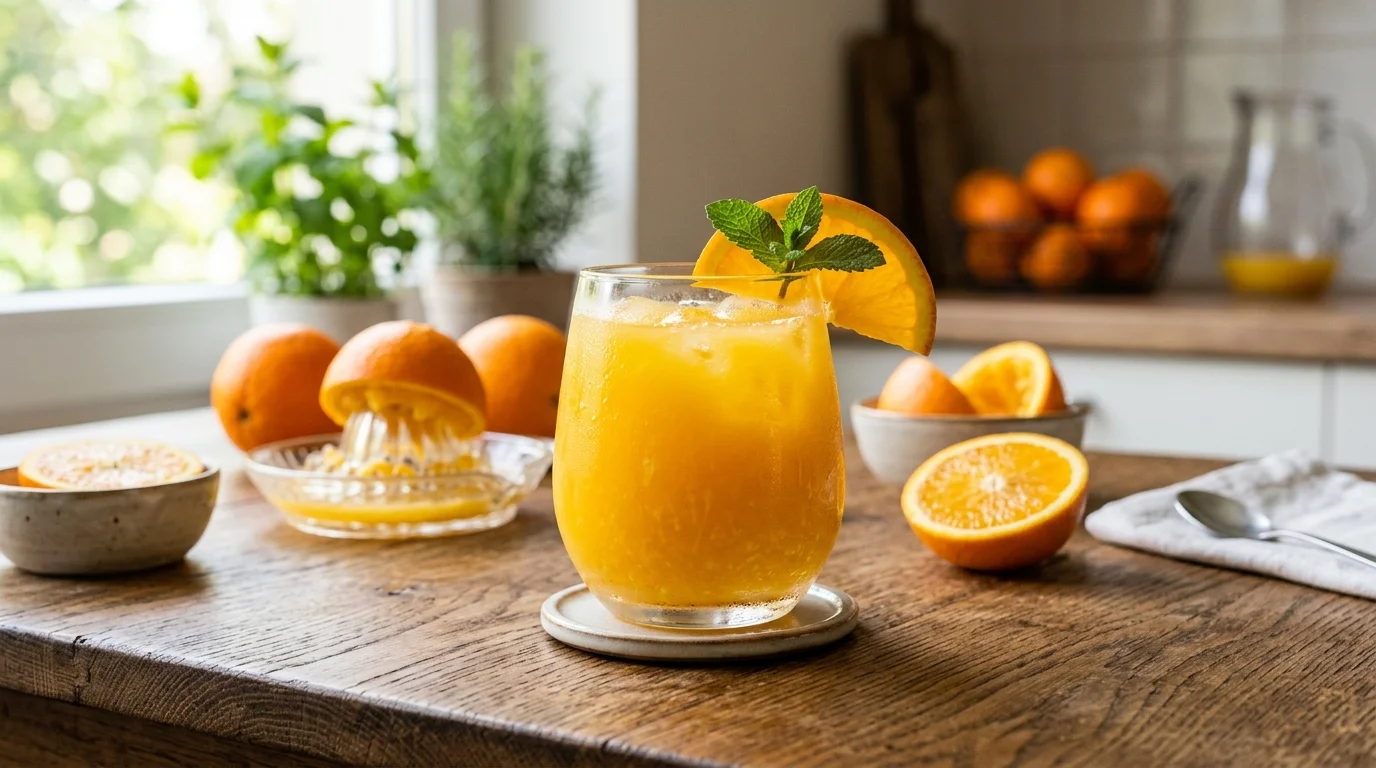
A properly made glass of fresh orange juice should look vibrant — deep orange-amber in colour, slightly hazy from the natural suspended citrus oils and fine pulp, and nothing like the uniform, clear colour of pasteurised commercial juice which has had its natural cloudiness filtered out. If the juice looks thin and pale, the oranges were under-ripe or too cold during juicing. If it looks very deep in colour with visible floating pieces, a second pass through the strainer produces a cleaner result. Chill the juice over ice in the serving glasses for 1–2 minutes before drinking — cold orange juice tastes sweeter and less acidic than room-temperature juice, and the temperature balance dramatically improves the overall drinking experience.
Pro Tip: Add a single large ice sphere or a few large ice cubes to each serving glass rather than crushed ice. Large ice melts slowly and keeps the juice cold without diluting it as quickly as small ice or crushed ice does. Fresh orange juice served over rapidly melting crushed ice becomes watery within 5 minutes — large ice maintains the correct flavour intensity from the first sip to the last.
Step 5: Taste and Fine-Tune
Before the glasses reach anyone else, taste the fresh orange juice carefully one final time and make any last adjustments. It should taste bright, naturally sweet with a clean acidic finish, and deeply aromatic — the volatile citrus compounds from the freshly cut skin produce a fragrance in fresh juice that disappears quickly, so the first glass is always the most aromatic. If building an upgraded version, this is the moment to add the lemon juice, ginger juice, or orange blossom water — stir through the full batch in the jug so every glass gets an even distribution of the added flavour. For a mint-forward version, muddle a small handful of fresh mint leaves with a pinch of sugar in the bottom of each serving glass before pouring the juice over.
Pro Tip: Fresh orange juice oxidises and loses its volatile aromatic compounds within 15–30 minutes of being squeezed — the first glass from a freshly squeezed batch tastes significantly better than the same juice left on the counter for 30 minutes before being served. Make fresh orange juice as close to serving time as possible and serve immediately rather than making it in advance. If advance preparation is necessary, store covered tightly in the refrigerator for up to 24 hours — cold slows the oxidation and flavour loss considerably.
Step 6: Garnish and Serve Immediately
Pour the chilled fresh orange juice over ice in tall, clear glasses — clear glass lets the vibrant amber colour of the fresh juice show through fully, which is part of the experience of serving freshly squeezed juice. Garnish each glass with a thin orange wheel balanced on the rim, a curl of orange zest, a sprig of fresh mint pressed against the inside of the glass, or a light dusting of cinnamon for a warming variation. Serve immediately — fresh orange juice is at its absolute best within 5 minutes of being squeezed, while the aromatics are still vivid, the colour is deepest, and every quality that distinguishes it from commercial juice is fully present. The sooner it’s drunk, the better it tastes.
Pro Tip: Chill the serving glasses in the freezer for 5 minutes before pouring. A frosted glass keeps the juice at the ideal cold temperature significantly longer than a room-temperature glass and looks impressive with minimal effort — the condensation on the outside of a frosted glass immediately signals freshness and quality to whoever receives it.
Cook Time
Total Time: 5 minutes | Prep: 3 minutes | Juice and Strain: 2 minutes One juicer, one strainer — fresh orange juice in 5 minutes.
Servings
Makes approximately 2 cups (480ml) — serves 2 to 4 depending on glass size.
Nutritional Information (approx. per serving — 1 cup / 240ml, no added sugar)
| Nutrient | Amount |
|---|---|
| Calories | 110 kcal |
| Fat | 0.5g |
| Saturated Fat | 0g |
| Carbohydrates | 26g |
| Protein | 2g |
| Sugar | 21g |
| Fiber | 0.5g |
| Sodium | 2mg |
| Vitamin C | 124mg |
| Potassium | 496mg |
| Calcium | 28mg |
Values are approximate and will vary based on orange variety and ripeness.
Storage Instructions
Fresh orange juice is best consumed within minutes of being squeezed — the volatile aromatic compounds that give it its distinctive freshness and fragrance begin dissipating immediately on exposure to air, and the quality of fresh juice is measurably better in the first 15 minutes than it is after 2 hours at room temperature. If storage is necessary, transfer the juice to an airtight sealed bottle or jar — fill it as close to the brim as possible to minimise air contact — and refrigerate immediately. Properly stored fresh orange juice keeps in the refrigerator for up to 24–48 hours before the fresh character becomes noticeably diminished. After 48 hours the juice is still safe to drink but tastes progressively more like commercial pasteurised orange juice and less like the freshly squeezed version that justified making it in the first place. For the best make-ahead approach for breakfast or a brunch gathering, juice the oranges no more than 12 hours before serving and store sealed and cold. Shake or stir before serving since natural pulp and citrus oils will have settled during storage. Freezing fresh orange juice in ice cube trays is the most practical long-term storage method — frozen fresh juice cubes keep for up to 3 months and can be added to smoothies, used in cocktails, or thawed as needed for single-glass servings. The flavour after freezing and thawing is noticeably less fresh than newly squeezed juice but significantly better than commercial alternatives. Never store fresh orange juice in an open container — exposure to air accelerates oxidation and the characteristic fresh flavour fades within an hour at room temperature.
Suggestions
- Orange Juice Mimosa: Combine equal parts fresh orange juice and chilled Prosecco or Champagne in a tall flute — pour the orange juice first, then the sparkling wine slowly down the side of the glass. The mimosa is the most universally served brunch cocktail and the quality of the fresh juice makes a fundamental difference to the finished drink. Freshly squeezed orange juice produces a mimosa that tastes genuinely celebratory rather than like sparkling wine mixed with juice from a carton.
- Fresh Orange and Carrot Juice: Add 2 medium carrots to the juicing process alongside the oranges — run them through an electric juicer or use a blender and strain through a fine mesh cloth. The carrot adds beta-carotene, a mild earthy sweetness, and a deeper amber colour to the finished juice. This combination is one of the most nutritionally complete fresh juice builds available and produces a glass that is genuinely rich and satisfying rather than just refreshing.
- Orange Ginger Wellness Shot: Juice 4 oranges and add 1 teaspoon of freshly pressed ginger juice — made by grating fresh ginger and pressing the pulp through a fine mesh strainer — alongside a squeeze of fresh lemon and a pinch of turmeric. Stir well and serve in small glasses as a concentrated morning wellness shot rather than a full serving. The anti-inflammatory properties of the ginger and turmeric combined with the vitamin C from the orange make this the most health-forward variation in the list.
- Orange Juice Smoothie: Blend 1 cup of fresh orange juice with 1 frozen banana, ½ cup of frozen mango, and a small handful of baby spinach for a fruit-and-vegetable smoothie that tastes primarily of orange and mango with none of the spinach flavour detectable. The fresh orange juice base produces a brighter, more aromatic smoothie than any commercial juice equivalent and its natural acidity helps preserve the colour of the blended spinach better than other liquids.
- Sparkling Orange Juice: Add equal parts fresh orange juice and good quality sparkling water or sparkling mineral water to a glass over ice. The carbonation adds a refreshing effervescence that makes fresh orange juice feel like a genuinely special soft drink without any added sugar or artificial flavouring. This is the most practical non-alcoholic alternative at a brunch table for guests who aren’t drinking — it looks similar to a mimosa and delivers all the freshness of the juice in a lighter, more refreshing format.
- Spiced Orange Juice: Simmer the squeezed orange juice very gently — not boiling — with a cinnamon stick, 2 whole cloves, and a star anise for 5 minutes. Strain and serve warm in mugs or chilled over ice for a cold version with warming spice. The brief infusion adds a winter-spice depth that makes orange juice a seasonal warm drink as appropriate as mulled wine during cooler months. Finish with a light dusting of cinnamon across the surface of each serving.
- Orange Juice With Lemon and Mint: Add 1 tablespoon of freshly squeezed lemon juice per cup of orange juice and stir through a handful of bruised fresh mint leaves — press the mint with a spoon against the side of the jug rather than muddling to avoid releasing harsh tannins from the leaves. The lemon sharpens the orange’s natural acidity into something cleaner and more defined, and the mint adds a cool, herbal note that makes this version particularly refreshing in summer. Strain the mint leaves before serving.
- Orange Juice for Cocktails: Fresh orange juice is the defining ingredient in a properly made Screwdriver, Harvey Wallbanger, Tequila Sunrise, and Sex on the Beach — the quality of the juice is the single variable that separates a cocktail that tastes fresh and well-balanced from one that tastes flat and sweet. For any cocktail application, squeeze the juice no more than 30 minutes before serving and use it immediately from the jug into the cocktail rather than storing in a refrigerator between juicing and mixing. The freshness of the juice is what the cocktail is built around.
Seasonal Relevance
Orange juice is available year-round from commercial sources, but the quality and character of freshly squeezed orange juice is genuinely seasonal. Valencia oranges — the best juicing variety — peak from March through October, with their highest sugar content and lowest bitterness in May and June. Navel oranges peak from November through April, making them the natural winter juicing orange when Valencias are out of season. December through February is when fresh navel orange juice is at its most appropriate and most appreciated — a glass of freshly squeezed juice on a cold winter morning is one of the most specifically seasonal pleasures available, and the vitamin C content is most relevant when cold and flu season is at its highest. From May through September, fresh orange juice sits naturally alongside summer fruit and light breakfast spreads — the mimosa version and the sparkling variation earn their place at brunch tables from spring through early autumn. The orange ginger wellness shot suits January and February most naturally — the post-holiday reset period when people are most motivated toward health-forward eating and the citrus season is at its peak. In all seasons, choosing the heaviest, most fragrant oranges at the market and juicing them immediately produces the best possible glass regardless of the month.
Conclusion
Fresh orange juice proves that the simplest version of a familiar thing is often the most satisfying version — six oranges, a juicer, and five minutes produce a glass that commercial production cannot replicate regardless of how much engineering and flavour science is applied to a carton. Roll the oranges before cutting, cut crosswise, press firmly but not hard at the end, add a pinch of salt to the batch, and serve immediately over large ice in a cold glass. Those five things produce a glass of orange juice that earns genuine appreciation rather than being taken for granted. Try the sparkling version for a non-alcoholic brunch option, the ginger wellness shot for a concentrated morning boost, the spiced warm version in winter, and the cocktail applications when the occasion calls for them. Every version starts from the same 5-minute foundation and every version is better than anything available in a bottle on a supermarket shelf.
FAQs
Q: How many oranges does it take to make one glass of orange juice? The yield varies by orange variety, size, and temperature, but as a general guide — 3 medium Valencia oranges produce approximately 1 cup (240ml) of fresh juice, which is a standard single serving. Navel oranges, which are larger and less juicy than Valencia, typically require 3–4 per cup. The heaviest oranges relative to their size always yield the most juice — lift a few before choosing and select the ones that feel unexpectedly dense. Rolling the oranges firmly against the counter for 10 seconds before cutting increases yield by up to 30% per orange and is worth doing for every batch regardless of variety.
Q: What is the difference between Valencia and navel oranges for orange juice? Valencia oranges are the superior juicing orange — they have a thinner skin, a higher juice content, and a flavour that is more complex and slightly more tart than navel oranges when squeezed. They are the variety used in most commercial orange juice production. Navel oranges are sweeter, less acidic, and larger — they produce a juice that is very pleasant but less aromatic and complex than Valencia. Navel oranges also contain compounds that become bitter when exposed to heat or prolonged air contact after juicing — they’re best consumed immediately after squeezing and don’t store as well as Valencia juice. For the freshest, most aromatic glass of orange juice, Valencia is always the better choice when available.
Q: Is freshly squeezed orange juice healthier than store-bought? Freshly squeezed orange juice retains significantly more of the volatile aromatic compounds, enzymes, and heat-sensitive micronutrients that are degraded during the pasteurisation process used in commercial production. Vitamin C content is higher in fresh juice — pasteurisation destroys a portion of the vitamin C in commercially processed juice. Fresh juice also contains no added preservatives, flavour packs, or stabilisers that are commonly used in commercially produced juice to maintain consistent flavour year-round. That said, both fresh and commercial orange juice contain similar amounts of natural sugar and similar caloric density — the health differences are primarily in micronutrient retention and the absence of additives rather than in the macronutrient profile.