Beef Stew Crock Pot Recipes Rich, Tender & Ready to Serve
Beef stew crock pot recipes are the most hands-off, most rewarding slow cooker project you can commit to on any morning because 8 hours later, without any further effort on your part, the kitchen smells extraordinary and there is a deeply rich, tender, fully developed beef stew waiting to be served.
The slow, low heat of a crock pot does something to beef chuck that no stovetop method can replicate in the same time — the collagen in the tougher cuts breaks down completely into gelatin, the vegetables absorb the broth without turning to mush, and the whole dish develops a depth of flavour that tastes like it’s been tended to all day. It works as a Sunday set-and-forget dinner, a weekday meal started before work and ready at 6pm, or a batch that feeds six people with leftovers worth looking forward to. No complicated steps — just pure beef stew crock pot recipe satisfaction, deeply rich and ready when you are.
Ingredients
For the Beef Stew:
- 900g (2 lb) beef chuck, cut into 1.5-inch cubes [chuck is non-negotiable — lean cuts dry out]
- 3 medium carrots, cut into 1-inch pieces
- 3 medium Yukon Gold potatoes, cut into 1.5-inch cubes
- 3 stalks celery, cut into 1-inch pieces
- 1 large yellow onion, roughly diced
- 4 cloves garlic, minced
- 2 cups (480ml) low-sodium beef broth
- 1 can (6 oz) tomato paste
- 2 tbsp Worcestershire sauce
- 1 tbsp soy sauce [umami booster — invisible in flavour, essential in depth]
- 1 tsp dried thyme
- 1 tsp dried rosemary
- 1 tsp smoked paprika
- 1 tsp onion powder
- ½ tsp fine salt
- ½ tsp black pepper
- 2 bay leaves
For Searing the Beef (Optional but Strongly Recommended):
- 2 tbsp olive oil
- ½ tsp salt and pepper for seasoning before searing
For Thickening the Stew:
- 3 tbsp all-purpose flour [tossed with beef before searing — OR]
- 2 tbsp cornstarch + 2 tbsp cold water [mixed into a slurry, added in the last 30 minutes]
Optional Add-Ins:
- 1 cup frozen peas — added in the last 30 minutes (optional)
- 1 cup sliced mushrooms (optional)
- ½ cup red wine — replaces ½ cup of the broth for depth (optional)
- 1 tbsp balsamic vinegar — added at the end for brightness (optional)
- Fresh parsley, for garnish
Step-by-Step Instructions
Step 1: Gather and Prep Your Ingredients
Before anything goes into the crock pot, get every vegetable cut and the beef cubed to the correct size. Beef chuck cubes should be at minimum 1.5 inches — smaller pieces overcook in an 8-hour low setting and produce dry, shredded meat rather than the tender, intact chunks that define a well-made beef stew crock pot recipe. Carrots and potatoes cut too small dissolve into the broth over 8 hours and lose all their texture — 1-inch pieces hold their shape through the full cook while still being tender enough to eat easily. Mince the garlic, dice the onion, and have the broth and tomato paste measured before the beef goes in the searing pan. Preparation done before the first ingredient hits heat keeps every step clean and efficient.
Pro Tip: Buy beef chuck and cut it yourself rather than using pre-cut beef stew meat from the supermarket. Pre-cut stew meat is often made from multiple cuts — some lean, some fatty, some from tougher sections — and cooks unevenly. Chuck cut to uniform 1.5-inch cubes from a single muscle cooks at the same rate, stays juicy throughout, and produces a stew where every piece is equally tender. The five extra minutes of cutting at home makes a measurable difference to the consistency of the finished dish.
Step 2: Sear the Beef Before It Goes In
This step takes 8 minutes and makes a significant difference — skip it only if time is genuinely not available. Toss the beef cubes with ½ teaspoon each of salt and pepper and 3 tablespoons of all-purpose flour. Heat 2 tablespoons of olive oil in a large, heavy skillet over high heat until smoking. Sear the beef in batches — never crowd the pan — for 2–3 minutes per side until a deep, mahogany-brown crust forms. Don’t move the beef during searing — contact time with the hot pan is what builds the crust, and lifting or shifting breaks the developing Maillard reaction. Transfer the seared beef to the crock pot. Deglaze the hot skillet with 2–3 tablespoons of the beef broth, scraping every caramelised bit from the bottom, and pour everything into the crock pot. Those bits are concentrated flavour.
Pro Tip: Searing the beef does two things that slow cooking alone cannot do — it builds flavour through the Maillard reaction on the surface of each piece, and the flour coating on the seared beef dissolves into the broth during slow cooking and thickens the stew naturally from within. A beef stew crock pot recipe made with seared, flour-coated beef produces a noticeably richer, darker, more complex broth than one where unseared beef goes directly into the crock pot. The 8 minutes is worth it every time.
Step 3: Layer the Crock Pot and Add the Liquid
Add the onion and garlic to the crock pot first — they go at the base because they release moisture that prevents the beef from sitting on a dry surface during the first hour of cooking. Add the celery, carrots, and potatoes in a single even layer on top of the onion base. Nestle the seared beef on top of the vegetables. In a jug, whisk together the beef broth, tomato paste, Worcestershire sauce, soy sauce, smoked paprika, thyme, rosemary, onion powder, salt, and pepper until the tomato paste is fully dissolved. Pour the liquid mixture over the beef and vegetables — it should come approximately two-thirds of the way up the contents of the crock pot. Add the bay leaves. Do not fill the crock pot more than two-thirds full — overfilling prevents proper circulation and produces an unevenly cooked stew.
Pro Tip: Put the harder, denser vegetables — potatoes and carrots — at the bottom of the crock pot closest to the heat source, and the beef on top. The vegetables take longer to cook than the beef and benefit from the direct base heat, while the beef benefits from the slower, more even heat in the upper portion of the slow cooker. This layering order produces consistently cooked vegetables and beef rather than overcooked beef and underdone potatoes.
📖 Read More: Beef and Broccoli
Step 4: Set and Slow Cook
Place the lid on the crock pot and cook on LOW for 8–10 hours or HIGH for 4–5 hours. The LOW setting is strongly preferred — the slower, more gentle heat breaks down the collagen in the beef chuck more completely and produces a more tender result than the HIGH setting, which can make the beef slightly tougher and the vegetables less distinct. Do not lift the lid during cooking — every time the lid is lifted, 15–20 minutes of heat and steam are lost and the cook time extends accordingly. The stew is ready when the beef is tender enough to break apart with a spoon and the vegetables yield easily to a fork without any resistance in the centre.
Pro Tip: Season the stew conservatively before slow cooking and adjust aggressively at the end — broth concentrates during a long slow cook and what tastes adequately seasoned going in will taste saltier coming out. Hold back on the salt initially, taste the finished stew after the full cook time, and season with salt, pepper, and a splash of Worcestershire at the end when you have an accurate reading of the actual seasoning level of the concentrated broth.
Step 5: Thicken the Stew and Final Adjustments
If the stew broth looks thinner than desired after the full cook time, mix 2 tablespoons of cornstarch with 2 tablespoons of cold water in a small bowl until completely smooth. Stir the cornstarch slurry into the hot stew, replace the lid, and cook on HIGH for 20–30 minutes until the broth has thickened to a coating, spoon-clinging consistency. Add the frozen peas in the same final 30-minute window if using — they cook through in the residual heat without becoming mushy or losing their colour. Remove the bay leaves. Taste the finished beef stew crock pot carefully and adjust — it may need more salt, a crack of fresh black pepper, or a tablespoon of balsamic vinegar to brighten the richness if the broth tastes flat or one-dimensional.
Pro Tip: A tablespoon of balsamic vinegar stirred into the finished beef stew crock pot recipe immediately before serving is the adjustment that makes everything taste more complex and more like a restaurant-quality broth. Acid in a slow-cooked dish functions exactly as salt does — it amplifies every other flavour by suppressing the flatness that comes from extended low-heat cooking. Add it gradually, taste after each addition, and stop when the broth tastes sharp and defined rather than mellow and slightly heavy.
Step 6: Serve and Garnish
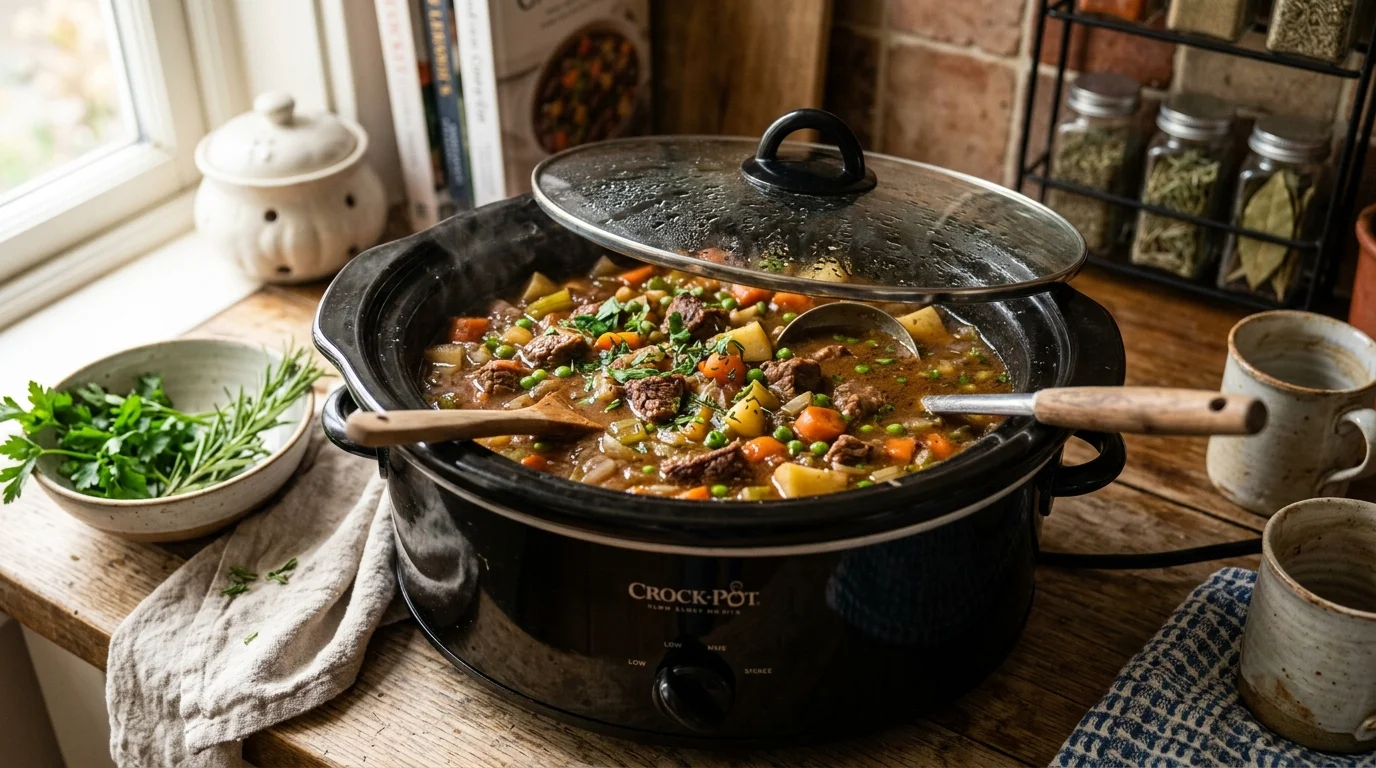
Ladle the finished beef stew into wide, deep bowls while it’s actively steaming — shallow bowls lose heat too quickly for a dish that is best eaten hot. Ensure each bowl receives a generous portion of beef chunks and an equal distribution of carrots, potatoes, and celery rather than just broth. Scatter freshly chopped flat-leaf parsley across the top — the green colour against the deep brown broth looks deliberate and finishes the bowl visually. Serve with crusty bread for the broth, buttered egg noodles for a more substantial meal, or over mashed potato for the richest, most warming version of the dish. The finished beef stew crock pot recipe should have a glossy, dark, deeply savoury broth that coats a spoon and beef that pulls apart without any resistance.
Pro Tip: Warm the serving bowls before ladling — fill them with hot tap water for 60 seconds, empty, and dry quickly before serving. A warm bowl keeps beef stew at the correct eating temperature from the first spoonful to the last. Cold bowls pull heat from the stew rapidly and the broth loses its glossy, liquid consistency within a few minutes of contact with room-temperature ceramic.
Cook Time
Total Time: 8–10 hours on LOW (or 4–5 hours on HIGH) | Active Prep: 20 minutes | Sear: 8 minutes | Slow Cook: 8 hours | Thickening: 30 minutes Active hands-on time: under 30 minutes. The crock pot does the rest.
Servings
Serves 6 generously from a standard 6-quart crock pot.
Nutritional Information (approx. per serving — based on 6 servings, with potatoes and carrots, no bread)
| Nutrient | Amount |
|---|---|
| Calories | 420 kcal |
| Fat | 18g |
| Saturated Fat | 6g |
| Carbohydrates | 28g |
| Protein | 38g |
| Sugar | 5g |
| Fiber | 4g |
| Sodium | 580mg |
| Vitamin C | 16mg |
| Potassium | 820mg |
| Calcium | 60mg |
Values are approximate and will vary based on ingredients used.
Storage Instructions
Beef stew crock pot recipes are among the best storage and meal prep dishes available — the stew genuinely tastes better on day two and three as the beef continues to absorb the broth and the flavours develop into something more rounded and complex than the freshly cooked version. Allow the stew to cool at room temperature for no more than 30 minutes before transferring to airtight containers and refrigerating — hot stew covered immediately traps steam that creates condensation and makes the broth watery by morning. Refrigerate for up to 4 days. The broth will gel slightly during refrigeration as the gelatin from the beef collagen solidifies — this is normal and a sign of quality. Reheat gently in a saucepan over medium-low heat or in the microwave in 60-second intervals, adding a small splash of broth if the stew looks thicker than desired after the gel has melted. For freezing, beef stew crock pot recipes freeze beautifully for up to 3 months with one caveat — potato texture degrades after freezing and thawing, becoming grainy and slightly mushy. For a freeze-ahead batch, make the stew without the potatoes and add freshly cooked potatoes when reheating from frozen. Alternatively, substitute parsnips or turnips for the potatoes — both freeze significantly better than potato and produce a similar hearty, starchy element in the stew after thawing. Freeze in individual portion containers for the most practical weekday meal prep — thaw overnight in the refrigerator and reheat as above.
📖 Read More: beef stroganoff
Suggestions
- Red Wine Beef Stew Crock Pot: Replace ½ cup of the beef broth with ½ cup of dry red wine — Cabernet Sauvignon, Merlot, or Côtes du Rhône all work well. Add the wine to the skillet after deglazing with broth and simmer for 60 seconds before pouring into the crock pot. The wine adds acidity, tannins, and a complexity to the broth that broth alone cannot produce — the alcohol cooks off entirely during the long slow cook and what remains is pure flavour depth. This is the most restaurant-quality version of the beef stew crock pot recipe in the list.
- Guinness Beef Stew Crock Pot: Replace ½ cup of the beef broth with ½ cup of Guinness stout. The Guinness adds a roasted, slightly bitter note to the broth that complements the beef deeply and produces a darker, richer broth than any other liquid addition. Add 1 teaspoon of brown sugar to balance the bitterness. This version is the most appropriate for cold weather — a genuinely warming, deeply savoury stew that belongs on a table in January.
- Mushroom Beef Stew Crock Pot: Add 2 cups of quartered cremini mushrooms to the crock pot alongside the standard vegetables. For maximum mushroom depth, soak ½ ounce of dried porcini mushrooms in ½ cup of hot water for 15 minutes — add both the rehydrated mushrooms and the soaking liquid (carefully poured, leaving any grit behind) to the crock pot. The porcini soaking liquid is one of the most concentrated umami additions available for any broth-based dish and transforms the standard beef stew into something noticeably more complex.
- Slow Cooker Beef and Vegetable Stew: Add 1 cup of diced parsnip, 1 cup of diced turnip, and 1 cup of frozen peas alongside the standard carrot and potato base. The parsnip adds a sweet, slightly anise-like note; the turnip adds earthiness; the peas add bright colour and sweetness in the final 30 minutes. This is the most nutritionally complete version of the beef stew crock pot recipe — the highest vegetable diversity, the widest range of micronutrients, and the most visually appealing finished bowl of any variation in this list.
- Beef Stew Crock Pot With Dumplings: Mix 1½ cups of self-raising flour with ½ cup of cold shredded butter and enough cold water to bring it together into a soft dough — about 6–8 tablespoons. Roll into 12 small balls and drop them directly onto the surface of the finished stew in the final 45 minutes of cooking on HIGH with the lid on. The dumplings steam on top of the stew and develop a pillowy, slightly doughy exterior that absorbs the broth beautifully. This version is the most substantial and comforting — a genuinely complete one-pot dinner that needs nothing alongside it.
- Spicy Beef Stew Crock Pot: Add 1 tablespoon of chipotle peppers in adobo, finely minced, to the liquid mixture before pouring into the crock pot. Add ½ teaspoon of cayenne and increase the smoked paprika to 2 teaspoons. The chipotle adds a slow, smoky heat that builds through the long cook and permeates every element of the stew. The heat level is warming rather than aggressive — the slow cook mellows the sharpest edges of the chili while leaving a genuinely noticeable warmth in every spoonful.
- Low-Carb Beef Stew Crock Pot: Replace the Yukon Gold potatoes entirely with diced radishes and diced turnips — both have a lower carbohydrate content and both become tender during the long slow cook in a way that closely resembles potato in texture once the raw sharpness has cooked out. Use cornstarch slurry for thickening rather than flour-coated beef, which eliminates additional carbohydrates from the thickening method. Each serving comes in under 320 calories and 14g of carbohydrates on this build while retaining every element of the flavour and satisfaction of the standard stew.
- Make-Ahead Frozen Beef Stew Crock Pot Meal: Combine the raw beef cubes, diced vegetables, spices, tomato paste, Worcestershire sauce, and soy sauce in a zip-lock freezer bag — do not add the broth yet. Seal, removing as much air as possible, and freeze flat for up to 3 months. When ready to cook, thaw overnight in the refrigerator. Empty the contents into the crock pot, add the broth, and cook on LOW as standard. The marinating effect of the spices and Worcestershire against the beef during freezing and thawing produces a more deeply seasoned result than fresh-assembled stew. This is the most practical meal prep approach for a household that wants crock pot beef stew available without any same-day prep.
Seasonal Relevance
Beef stew crock pot recipes are the defining dish of autumn and winter — from October through February they are the single most appropriate slow cooker meal available. The warming, deeply savoury broth, the falling-apart beef, and the tender root vegetables all belong to the season when the house needs warmth as much as the body does, and a crock pot that has been running all day delivers both simultaneously. December and January are when the Guinness version and the red wine build get made most frequently — richer, deeper, more appropriate for the coldest nights of the year. The dumpling variation specifically belongs to November and December when a one-pot dinner that requires nothing alongside it suits the season’s appetite for maximum comfort with minimum effort. From March through May, beef stew transitions away from its peak — the appetite for heavy, slow-cooked food decreases as the weather warms and lighter meals start to feel more appropriate. Spring is when the vegetable-heavy version with parsnip and peas gets its last weekly appearance before the summer hiatus. From June through September, beef stew crock pot recipes take a back seat — the format is too warming and too long-cooking for hot weather, and the appetite is naturally drawn toward lighter, faster dishes. The exception is the first cool autumn evening in September or October when the crock pot gets set for the first time in months and the kitchen fills with the smell of beef and thyme — that moment makes the whole seasonal rotation worth waiting for.
Conclusion
Beef stew crock pot recipes earn their place as one of the most reliable, most satisfying slow cooker dishes because the method and the ingredient align perfectly — a tough, collagen-rich cut of beef given low, slow, extended heat in seasoned broth produces something that can only be described as genuinely worth the wait. Sear the beef before it goes in, layer the vegetables correctly, season conservatively before cooking and boldly at the end, and add the balsamic adjustment to the finished stew. Those four things done consistently produce a beef stew crock pot recipe that tastes like it was made with professional technique and hours of active attention — when the truth is it took 20 minutes and ran unattended while you went about your day. Make the classic version first, understand the broth and the beef texture you’re aiming for, and then work through the variations — Guinness, mushroom, dumplings, red wine. Every version is worth making and every version is better the next day.
FAQs
Q: Can I put raw beef directly into the crock pot without searing it first? Yes — raw, unseared beef can go directly into the crock pot and will cook through safely on LOW for 8–10 hours. The finished stew will be safe and the beef will be tender. What you lose is flavour — specifically the Maillard reaction on the surface of the beef that produces the hundreds of complex flavour compounds responsible for the deep, savoury character of a properly browned crust. Unseared beef produces a paler broth and a less complex flavour profile than seared beef. If time doesn’t allow searing, increase the Worcestershire sauce to 2 tablespoons and add 1 extra tablespoon of tomato paste to compensate — both are umami amplifiers that partially bridge the flavour gap that skipping the sear creates.
Q: Why is my beef stew crock pot broth watery and thin? Thin broth in a crock pot beef stew comes from one of three causes — the crock pot was overfilled beyond two-thirds capacity which prevents adequate evaporation and concentration, the flour coating on the beef was skipped which removes the built-in thickener, or the cornstarch slurry wasn’t added at the end to finish the consistency. For an already-thin stew, mix 2 tablespoons of cornstarch with 2 tablespoons of cold water until smooth, stir into the stew, replace the lid, and cook on HIGH for 20–30 minutes until thickened. For future batches, coat the beef in flour before searing and avoid exceeding the two-thirds fill line. A splash of red wine or balsamic vinegar also concentrates the flavour significantly when the broth tastes thin.
Q: Should I cook beef stew crock pot recipes on LOW or HIGH? LOW for 8–10 hours is always the preferred setting for beef stew. The lower, gentler temperature breaks down the collagen in beef chuck more completely — the collagen converts to gelatin at lower temperatures over longer periods, and this gelatin is what gives the broth its glossy, coating, restaurant-quality body. HIGH cooking also works and produces a safe, tender result in 4–5 hours, but the higher temperature can tighten the muscle fibres in the beef slightly before the collagen has fully broken down, producing a marginally tougher texture than the LOW equivalent. If time requires HIGH cooking, reduce the beef cube size to 1 inch to help them reach tenderness more quickly within the shorter cook window.