Soft Homemade Sandwich Bread
Yield: 1 loaf (8½ × 4½ inch / 22 × 11 cm loaf pan)
Ingredients
Dry Ingredients
- 500 g (4 cups) bread flour
- 10 g (2 tsp) instant yeast
- 30 g (2½ tbsp) sugar
- 8 g (1½ tsp) salt
Wet Ingredients
- 300 ml (1¼ cups) warm milk (100–110°F / 38–43°C)
- 45 g (3 tbsp) unsalted butter, softened
- 1 large egg (50 g)
Egg Wash
- 1 egg
- 1 tbsp milk
Nutrition (Approximate)
Per loaf
- Calories: 2,000
- Protein: 60 g
- Carbohydrates: 320 g
- Fat: 50 g
Per slice (12 slices)
- Calories: 165–175
- Protein: 5 g
- Carbs: 27 g
- Fat: 4 g
Values are approximate and vary by ingredients used.
Equipment
- Mixing bowl
- Kitchen scale (recommended)
- Stand mixer (optional)
- Dough scraper
- 8½ × 4½ inch loaf pan
- Plastic wrap or towel
- Oven
- Cooling rack
Step 1 — Mix
Combine:
- Flour
- Sugar
- Salt
- Yeast
Add:
- Warm milk
- Egg
Mix until shaggy.
Add softened butter.
Step 2 — Knead
Knead for:
- Stand mixer: 8–10 minutes
- By hand: 12–15 minutes
The dough should become:
- Smooth
- Elastic
- Slightly tacky
Windowpane test:
Stretch a small piece. It should become thin without tearing.
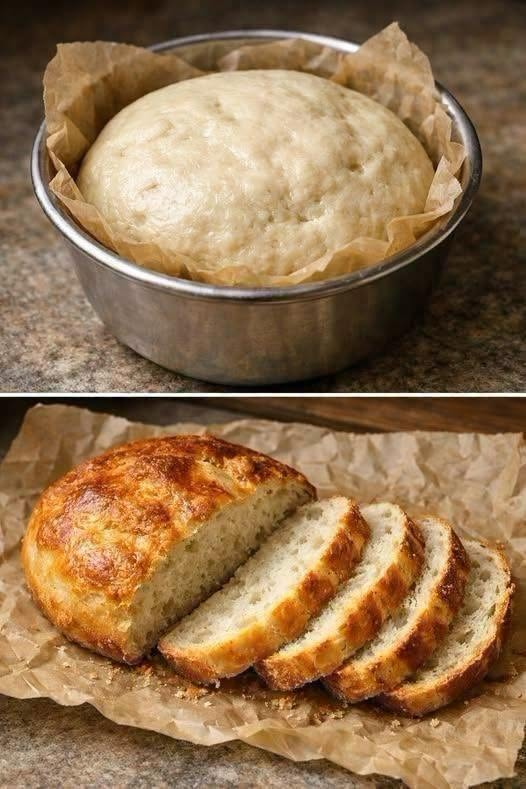
Step 3 — First Rise (Image 1–2)
Place dough into a lightly oiled bowl.
Cover.
Rise until doubled.
Time:
- 60–90 minutes
Ideal temperature:
75–80°F (24–27°C)
Step 4 — Degas (Image 3)
Punch down gently.
Do not tear the dough.
Turn onto a lightly floured surface.
Step 5 — Shape (Image 4)
Flatten into a rectangle.
Approximate size:
8 × 12 inches
Press out large air bubbles.
Step 6 — Roll (Image 5)
Roll tightly from the short side.
Seal the seam by pinching.
Tuck both ends underneath.
Step 7 — Pan (Image 6)
Place seam-side down into a greased loaf pan.
Step 8 — Final Proof (Image 7)
Cover loosely.
Rise until dough reaches:
- 1 inch above pan
- or about doubled
Usually:
45–60 minutes
Do not over-proof.
Step 9 — Egg Wash (Image 8)
Whisk:
- 1 egg
- 1 tablespoon milk
Brush lightly over loaf.
Step 10 — Bake (Image 9)
Bake at:
350°F (175°C)
Time:
30–35 minutes
Internal temperature:
190–200°F (88–93°C)
Top should be:
- Deep golden brown
If browning too quickly:
Cover loosely with foil during the last 10 minutes.
Cooling
Remove from pan after:
10 minutes
Cool completely on a rack for at least:
1 hour
Slice only after cooling.
Storage
Room temperature:
- 3–4 days
- Airtight container
Refrigerator:
- Up to 1 week (may dry faster)
Freezer:
- Up to 3 months
Freeze sliced for easy use.
Baker’s Tips
✔ Use bread flour for a taller loaf.
✔ Measure ingredients by weight for best results.
✔ Milk should be warm, not hot.
✔ Knead until smooth and elastic.
✔ Don’t add too much extra flour.
✔ A tight roll creates a beautiful loaf.
✔ Let the bread cool before slicing.
Variations
Butter Bread
Increase butter to 60 g.
Honey Bread
Replace sugar with 40 g honey.
Reduce milk by 15 ml.
Whole Wheat
Use:
- 300 g bread flour
- 200 g whole wheat flour
Increase milk by 20–30 ml.
Milk Bread
Replace part of the milk with 100 g heavy cream for an even softer crumb.
Troubleshooting Q & A
Q: Why didn’t my bread rise?
A: Possible reasons:
- Expired yeast
- Milk too hot (killed yeast)
- Cold room
- Too much salt contacting the yeast directly
Q: Why is my bread dense?
A: Usually caused by:
- Not enough kneading
- Under-proofing
- Too much flour
Q: Why did the loaf collapse?
A: Most often from over-proofing or under-baking.
Q: Why is the crust hard?
A: Baking too long or at too high a temperature. Brushing the hot loaf with melted butter also helps soften the crust.
Q: Can I use all-purpose flour?
A: Yes. The loaf will still be good but slightly less tall and chewy than with bread flour.
Q: Can I make it without eggs?
A: Yes. Omit the egg and add about 50 ml (3 tbsp + 1 tsp) extra milk. The bread will be slightly less rich.
Q: Can I use active dry yeast?
A: Yes. Use the same amount (10 g), but dissolve it in the warm milk with the sugar and let it stand for 5–10 minutes until foamy before mixing.
Q: Can I make the dough ahead?
A: Yes. After kneading, refrigerate the dough overnight (8–24 hours). Let it come to room temperature for 30–60 minutes before shaping and proofing.
Q: Why are there large holes inside?
A: Large air pockets are often caused by not pressing out trapped air before rolling or by shaping too loosely.
Q: How do I know when it’s fully baked?
A: The loaf should be deep golden, sound hollow when tapped on the bottom, and register 190–200°F (88–93°C) internally with an instant-read thermometer.