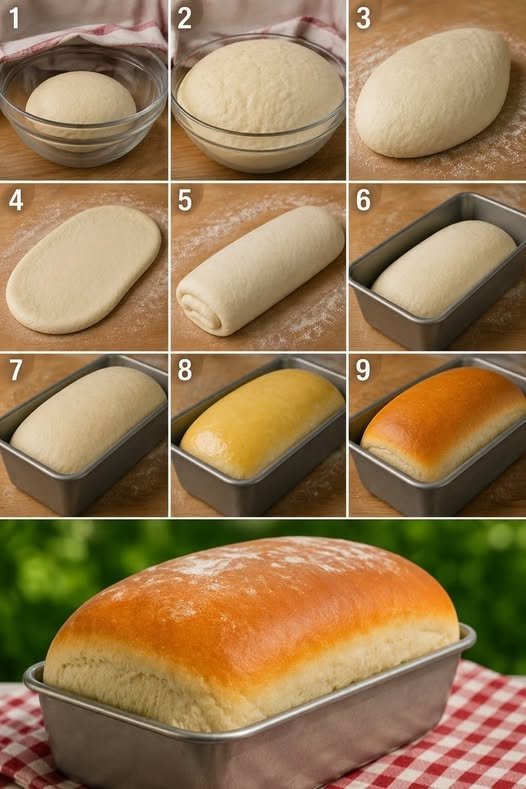
Soft, Fluffy Stuffed Pan Flatbreads
The exact original recipe can’t be determined from the photograph alone, so the recipe below is a copycat-style version designed to produce the same appearance and texture.
Quick Recipe
Makes: 8–10 flatbreads
Prep: 25 minutes
Resting: 60–90 minutes
Cooking: 20–25 minutes
Total: about 2 hours
🛒 Ingredients
For the dough
4 cups (500 g) all-purpose flour
1½ tsp salt
1 tbsp sugar
2 tsp instant yeast
1½ cups (360 ml) warm water, approximately
3 tbsp plain yogurt
2 tbsp vegetable oil or olive oil
1 tbsp melted butter, optional
For the layering
3 tbsp melted butter or ghee
2 tbsp vegetable oil
2 tbsp flour
Mix the butter, oil and flour into a smooth, spreadable paste.
Optional filling
The photo can also be reproduced as an unstuffed bread. If you want a filled version, use:
1½ cups shredded mozzarella
½ cup grated cheddar
2 tbsp chopped parsley/cilantro
½ tsp black pepper
½ tsp garlic powder
½ tsp chili flakes, optional
👩🍳 Step 1 — Make the dough
Put the flour into a large bowl.
Add:
salt
sugar
instant yeast
Mix well.
Add the yogurt and about 1¼ cups of warm water.
Start mixing with your hand or a wooden spoon.
Gradually add the remaining water until you have a soft, slightly sticky dough.
Don’t add all the water at once because flour absorbs different amounts of moisture.
Step 2 — Knead
Add 2 tbsp oil.
Knead for approximately 8–10 minutes.
The finished dough should be:
smooth
elastic
soft
slightly tacky
not dry
Important
Don’t compensate for sticky dough by immediately adding lots of flour.
A slightly soft dough produces much softer flatbreads.
If it’s extremely sticky, add flour 1 tablespoon at a time.
Step 3 — First rise
Lightly oil the bowl.
Put the dough inside and turn it once so the surface is coated.
Cover with plastic wrap or a clean kitchen towel.
Leave somewhere warm for approximately 60–90 minutes, or until roughly doubled in size.
Step 4 — Prepare the layering mixture
Mix:
3 tbsp melted butter/ghee
2 tbsp oil
2 tbsp flour
You should have a soft paste.
This mixture is important because it creates the layers and fluffy interior visible when the bread is pulled apart.
Step 5 — Divide the dough
Punch the dough down gently.
Divide it into 8 equal pieces for large flatbreads, or 10 pieces for smaller ones.
Roll each piece into a ball.
Brush lightly with oil.
Cover and let them rest for 15–20 minutes.
This relaxation period makes the dough much easier to stretch.
🫓 Step 6 — Create the layers
Take one dough ball.
Lightly oil your work surface.
Flatten the dough with your fingers.
Gently stretch it into a thin circle.
It doesn’t need to be perfectly round.
Spread a very thin layer of the butter/oil/flour mixture over the surface.
For unstuffed bread
Fold the dough:
Fold the top toward the center.
Fold the bottom over it.
Fold the left side toward the center.
Fold the right side over it.
You should end up with a compact square/package.
Tuck the edges underneath and gently roll into a ball.
🧀 For stuffed flatbread
After spreading the butter mixture, put approximately:
2–3 tbsp mozzarella
1 tbsp cheddar
a little parsley
black pepper
chili flakes
in the center.
Fold the edges toward the middle and seal completely.
Don’t overfill it.
Too much cheese can cause the filling to leak during cooking.
Step 7 — Rest again
Place the formed balls on an oiled tray.
Cover.
Rest for 10–15 minutes.
This makes them easier to flatten without tearing.
Step 8 — Flatten
Take one ball.
Using your fingers, gently press it into a thick round approximately:
15–18 cm / 6–7 inches wide
and about ½–¾ inch thick.
Don’t roll it aggressively with a rolling pin.
The goal is to retain some air inside.
That is what gives the finished bread its puffy, soft texture.
🔥 Step 9 — Cook on a skillet
Heat a heavy skillet, cast-iron pan or tawa over medium heat.
You don’t need a large amount of oil.
Place one flatbread on the hot surface.
Cook approximately 2–3 minutes.
You should see small bubbles forming.
Turn it over.
Cook another 2–3 minutes.
Turn again if necessary.
Press gently around the edges with a spatula.
🧈 Step 10 — Butter the bread
When golden spots appear on both sides, brush lightly with:
melted butter, or
ghee
Don’t drown it in butter.
A light coating keeps the bread flavorful while maintaining the soft exterior.
🔥 The secret to soft bread
As soon as each flatbread is cooked, place it in a clean kitchen towel or covered container.
Stack the breads together.
The trapped steam keeps them soft.
This is particularly important if you’re making 8–10 breads.
Don’t leave the cooked breads uncovered on a plate, or the surface can become dry.
🥘 How to Get the Exact Puffy Appearance
For bread resembling the photograph:
Use a soft dough
The dough should be softer than ordinary pizza dough.
Don’t over-flatten
Leave it around ½–¾ inch thick before cooking.
Medium heat
High heat browns the outside too quickly.
Cover briefly
If the bread is browning before the inside is cooked, reduce the heat and cover the skillet for about 30–60 seconds.
Stack immediately
This preserves the steam and softness.
🌿 Flavor Variations
Garlic & Herb
Add to the butter mixture:
2 minced garlic cloves
1 tbsp parsley
½ tsp oregano
pinch of black pepper
Cheese & Chili
Use:
mozzarella
cheddar
chili flakes
green chili
cilantro
Excellent with yogurt or chutney.
Potato Stuffing
Filling
3 medium potatoes, boiled
½ tsp salt
½ tsp cumin
½ tsp coriander powder
½ tsp chili powder
¼ tsp black pepper
1 green chili, chopped
2 tbsp cilantro
½ tsp garam masala
Mash everything together.
Use about 2–3 tbsp filling per flatbread.
Seal carefully before flattening.
Spiced Meat Filling
Cook:
250 g ground beef or lamb
½ small onion
1 garlic clove
½ tsp cumin
½ tsp paprika
½ tsp coriander
¼ tsp black pepper
salt to taste
Cook until the meat is completely done and fairly dry.
Cool completely before filling the dough.
📊 Approximate Nutrition
For 1 of 10 plain flatbreads, assuming the recipe uses approximately 2 tbsp oil plus 3 tbsp butter:
Nutrient Approx.
Calories 240–270 kcal
Protein 6–7 g
Carbohydrates 36–40 g
Fat 8–10 g
Saturated fat 3–4 g
Fiber 1–2 g
Sugar 1–2 g
Sodium 300–450 mg
Calcium 25–50 mg
These are estimates. The actual nutrition depends heavily on flour, yogurt, butter/oil, filling and portion size.
Cheese-filled version
Expect approximately 50–100+ additional calories per bread, depending on the amount and type of cheese.
🥗 What to Serve With It
These flatbreads are excellent with:
plain yogurt
garlic yogurt
cucumber raita
mint chutney
coriander chutney
tomato chutney
hummus
scrambled eggs
lentil soup
chicken curry
vegetable curry
grilled meat
For breakfast, try one with eggs + yogurt + fresh vegetables.
❓ Frequently Asked Questions
Why is my bread hard?
Usually one of these:
Too much flour.
Dough wasn’t kneaded enough.
Dough didn’t rest sufficiently.
Skillet was too hot.
Bread was cooked too long.
Cooked breads weren’t covered.
The biggest mistake is generally making the dough too dry.
Why isn’t my bread fluffy?
The most common reasons are:
insufficient yeast fermentation
dough too stiff
insufficient resting
flattening too aggressively
excessive flour during shaping
Give the dough enough time to rise and keep it soft.
Can I make it without yeast?
Yes.
For a quicker version, replace the yeast with:
2 tsp baking powder
½ tsp baking soda
The texture will be somewhat different—more like a quick flatbread than a yeast-raised bread.
Can I use whole-wheat flour?
Yes, but 100% whole wheat will generally produce a denser bread.
For a softer result, try:
2 cups all-purpose flour + 2 cups whole-wheat flour.
You may need a little additional water.
Can I use milk instead of water?
Yes.
Use warm milk for a richer, softer flatbread.
You can replace approximately half the water with warm milk.
Can I make the dough the night before?
Yes.
After kneading, cover it tightly and refrigerate.
The next day, let it sit at room temperature for approximately 30–60 minutes before shaping.
Can I freeze the flatbreads?
Yes.
Let cooked breads cool completely.
Separate them with parchment/baking paper and place them in a freezer bag.
Freeze for approximately 2–3 months for best quality.
Reheat directly from frozen in a covered skillet over low-medium heat.
How do I reheat them without making them hard?
Best method:
Put the bread in a skillet.
Sprinkle a few drops of water around it.
Cover.
Heat over low-medium heat for 1–2 minutes per side.
The steam restores softness.
Can I cook these in an oven?
Yes, although a skillet gives the characteristic toasted spots shown in the photo.
Bake at approximately 220°C / 425°F until puffed and golden, usually around 8–12 minutes, depending on thickness.
Can I use an air fryer?
Yes, but don’t expect exactly the same texture.
Try approximately 180°C / 350°F for 5–8 minutes, checking frequently.
Why does the filling come out?
Usually because:
the filling is too wet
too much filling was used
the dough wasn’t sealed properly
the dough was stretched too thin around the filling
Keep the filling relatively dry and leave a clean border around the edges before sealing.
How do I make the layers more visible?
Use the butter/oil/flour paste thinly but evenly.
Then fold the dough rather than simply rolling it into a ball.
Don’t knead the folded dough again, because that destroys the layers you’ve created.
⭐ Best Formula for the Photograph
If your goal is specifically the soft, thick, golden, pull-apart bread shown in the image, I’d use:
500 g flour + 360 ml water + 3 tbsp yogurt + 2 tsp yeast + 2 tbsp oil, followed by butter/oil layering, gentle flattening, and medium-heat skillet cooking.
The most important three things are: